Over the last few weeks the I’ve been putting together multi-cloud conversations and material related to multi-cloud implementation, conversations, and operational situations that exist today. I took a quick look at some of my repos on Github and realized I’d put together a multi-cloud Node.js sample app some time ago and should update it. I’ll get to that, hopefully, but I also stumbled into some tweets and other material I wanted to collect a few of them together.
Our Killrvideo Reference Application Work @ DataStax which we’ll have more coverage of, blog entries, and related material coming out in the coming weeks about what we’ve been doing to make this reference application multi-cloud ready and then multi-cloud capable.
A well worded tweet… lot’s of talk per Google’s somewhat underlying push for GKE on prem. Which means more clouds, more zones, and more multi-cloud options.
MyPOV: @googlecloud announces GKE on prem. It's just another zone.
Here's to #multicloud and a consistent approach across all deployment types
— @ces R “Ray” Wang 王瑞光 #1A #RuleTheWorld #CES2021 (@rwang0) July 24, 2018
Distributed Data Show Conversations
Leave a comment, tweet at me (@adron), let me know your thoughts or what you’re working on re: multi-cloud. I’m curious to learn about and know more war stories.
But to the rescue comes the search engine. I found some material on the matter and, as I’ve learned frequently, don’t count out Linux when it comes to support of nearly everything on Earth. Sure enough, there’s support for exFAT (really, why wouldn’t there be?)
Check out this repo: https://github.com/relan/exfat
There’s of course the git clone and make and make install path or there’s also the apt install path.
git clone https://github.com/relan/exfat.git
cd exfat
autoreconf --install
./configure
make
Then make install.
make install
Of course, as with things on Linux, no reboot needed just use it now to mount a drive.
mount.exfat-fuse /dev/spec /mnt/exfat
To note, if you’re using Ubuntu 18.04 the support will just be available now so re-click on the attached drive or memory device you’ve just attached and it will now appear. Pretty sweet. If you want to use apt just run this command.
UPDATED: April 4th, 2019, March 17th, 2022, and again on November 18th, 2024.
It seems every few months setup of whatever tech stack is always tweaked a bit. This is a collection of information I used to setup my box recently. First off, for the development box I always use nvm as it is routine to need a different version of Node.js installed for various repositories and such. The best article I’ve found that is super up to date for Ubuntu 18.04 is Digital Ocean’s article (kind of typical for them to have the best article, as their blog is exceptionally good). In it the specific installation of nvm I’ve noticed has changed since I last worked with it some many months ago.
First curl download the installation script. I trust the script so I just install it from the repo! (Albeit I HAVE read it multiple times, remember, don’t just run scripts from random repos!)
UPDATE November 18, 2024 – curl -o- https://raw.githubusercontent.com/nvm-sh/nvm/v0.40.1/install.sh | bash to get the latest installed.
Now that I’ve gotten the script and run it, I can then source ~/.profile and nvm is now available. Check out the versions available for installation with nvm ls-remote. Next up, install a particular version, or a few, as in my case I’ll need a couple.
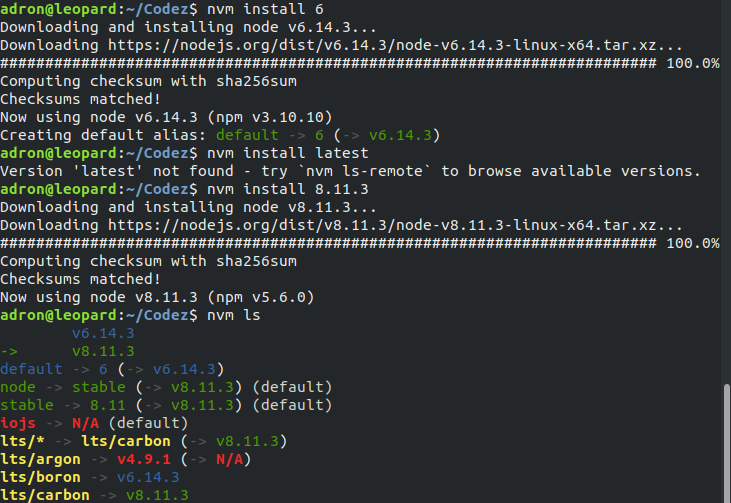
After this I ran a nvm ls command to see what was installed altogether. Note for my installation of version 6, with the nvm install 6 command it chose version 6.14.3 as it will choose latest for any major release version specified.
Beyond the version manager installed version there’s also the package manager on Debian/Ubuntu that can be used, but requires a few additional steps but is good if the installation will be used to host a specific Node.js application at a particular version. More details on that installation method can be found here.
Next up I finalized my installation. After getting a list of the latest versions with nvm ls-remote I chose 10.15.3 with the nvm use 10.15.3 command. For a list of the local versions of Node.js I can now use nvm ls and check the current version in use with node -v.
For the latest updates check out the repository for NVM here.
Boarded the 17x King County Metro Bus at 6:11am yesterday. The trip was entirely uneventful until we arrived in Belltown in downtown Seattle. A guy with only his underwear on boarded the bus. Yup, you got that right, just like those underwear nightmares people have! That guy was living this situation for whatever unknown reasons. He didn’t make to much fuss though and eventually settled into one of the back seats on our packed bus.
Downtown as I got off I was pleasantly surprised that Victrola was open in the newly leased Amazon building near Pine & Pike on 3rd. I remember it being built and opening, but for some reason had completely forgotten it was there until today. Having a Victrola at this location sets it up perfectly for the mornings one needs to get to the airport. It’s located in a way that you can get off any connecting bus, grab an espresso at Victrola, and then enter the downtown tunnel to board LINK to the airport. Previously, the only option was really to wait until you get to the airport and buy some of the lackluster espresso coffee trash options they have at SEATAC.
Once I boarded the LINK I got into some notes for the upcoming Distributed Data Show that I would be recording while in San Francisco. But also got into a little review of some Node.js JavaScript code that I’d pulled down previously. I’ve been hard pressed to get into the code base and add some updates, logging, and minor logic for Killrvideo. Hopefully today, or maybe even this evening while I’m on the rest of this adventure.
All the things in between then occurred. The flight to San Jose, the oddball Taxi ride to Santa Clara DataStax HQ, then the Lyft ride to Caltrain to ride into downtown San Francisco to my hotel. Twas’ an excellently chill ride into the city and even a little productive. A good night of sleep and then up and at em’. Headed to the nearest Blue Bottle, which was on the way to my next effort of the trip. Blue Bottle was solid as always, and into the studios I went.
Multi-Cloud Conversations
At this point of this quick trip I’ve just finished shooting a few new episodes of the Distributed Data Show (subscribe) with Jeff Carpenter (@jscarp) and Amanda Moran (@amandadatastax). Just recently I also got to shoot an episode with Patrick McFadin (@patrickmcfadin) too. We’ve been enjoying a number of conversations around multi-cloud considerations, what going multi-cloud means, and even what exactly does multi-cloud even really mean. It’s been fun and now I’m putting together some additional blog posts and related material to follow the posts with more detail. So keep an eye out for the Distributed Data Shows. You can also take the lazy route and subscribe to be notified when new episodes are released or you could even set your calendar for every Tuesday, because we follow an old school traditional schedule approaches to episode releases.
I’ve included a recap on a few of the recent episodes below, which you may want to check out just to get an idea of what’s to come. Great as a listen while commuting, something to put on while you’re relaxing a bit but want to think about or listen to a conversation on a topic, or just curious what’s up!
In this last episode DataStax Vanguard Lead Chelsea Navo (@mazdagirluk) joined in to talk about how the team helps enterprises meet the challenges posed by disrupting technology and competitors. Some of the highlights of the conversation include:
1:57 Defining what exactly enterprise transformation is.
4:00 Trends including retooling batch workloads around real-time requirements, handing larger data sets and the uber popular use of streaming data we see today.
7:37 Techniques on getting teams trained up on cutting-edge technology.
9:46 There’s an argument for “skateboard solutions“! I now want to write up a whole practice around this!
16:27 Data modeling. Challenges of. Challenges around. Data modeling, it’s a good topic of exploration.
25:56 The data layer is still typically the hardest part of your application! (The assertion is made; agree, disagree, or ??)
Jonathan Lacefield (@jlacefie) joins this episode to discuss the history of DataStax Enterprise Graph, common use cases, and future directions including multi-model enhancements.
1:56 – Jonathan gives us a quick overview of graph database history at DataStax – Titan Aurelius, Apache TinkerPop, and key figures like Marco Rodriguez (@twarko) and Matthias Broecheler (@mbroecheler).
5:48 – Using Cassandra as the pluggable storage layer for Titan led to the creation of DataStax Enterprise Graph
8:40 – The natural relationship between graph processing and analytics/graph analytics. The trend is toward abstracting the operational/analytic choice from the application developer.
17:28 – Problems being solved with graph databases – Customer 360, Authorization, Entity Resolution.
22:22 – Continued support for multi-model, hybrid cloud, writing data once and accessing through the right API for the job – CQL, SQL, Gremlin
27:37 – Graph query languages like Gremlin, Cypher require a paradigm shift for developers – domain specific languages provide a way to minimize this learning curve.
A Network of Excellent People
Amidst those episodes, and good people to follow on many of the topics we discuss and will be discussing on the show, give these people a follow. Lot’s of good content, good thinking – sometimes controversial – and a lot of smarts among them all.
I just finished and got a LinkedIn Learning (AKA Lynda.com) course published last month on Learning Terraform (LinkedIn Learning Course & Lynda.com Course). Immediately after posting that I spoke with my editor at LinkedIn Learning and agreed on the next two courses I’ll record: Terraform Essentials and Go for Site Reliability Engineers. Consider me stoked to be putting this material together and recording more video courses, this is a solid win, as the internet dogge would say, “much excite, very wow”!
The following are some recent materials I’ve dug up in regards to Terraform, Go, and Site Reliability work. Some of which will very likely find it’s way into influencing my courses. Good material here if you’re looking for some solid, and arguably more advanced approaches, to your Terraform work.