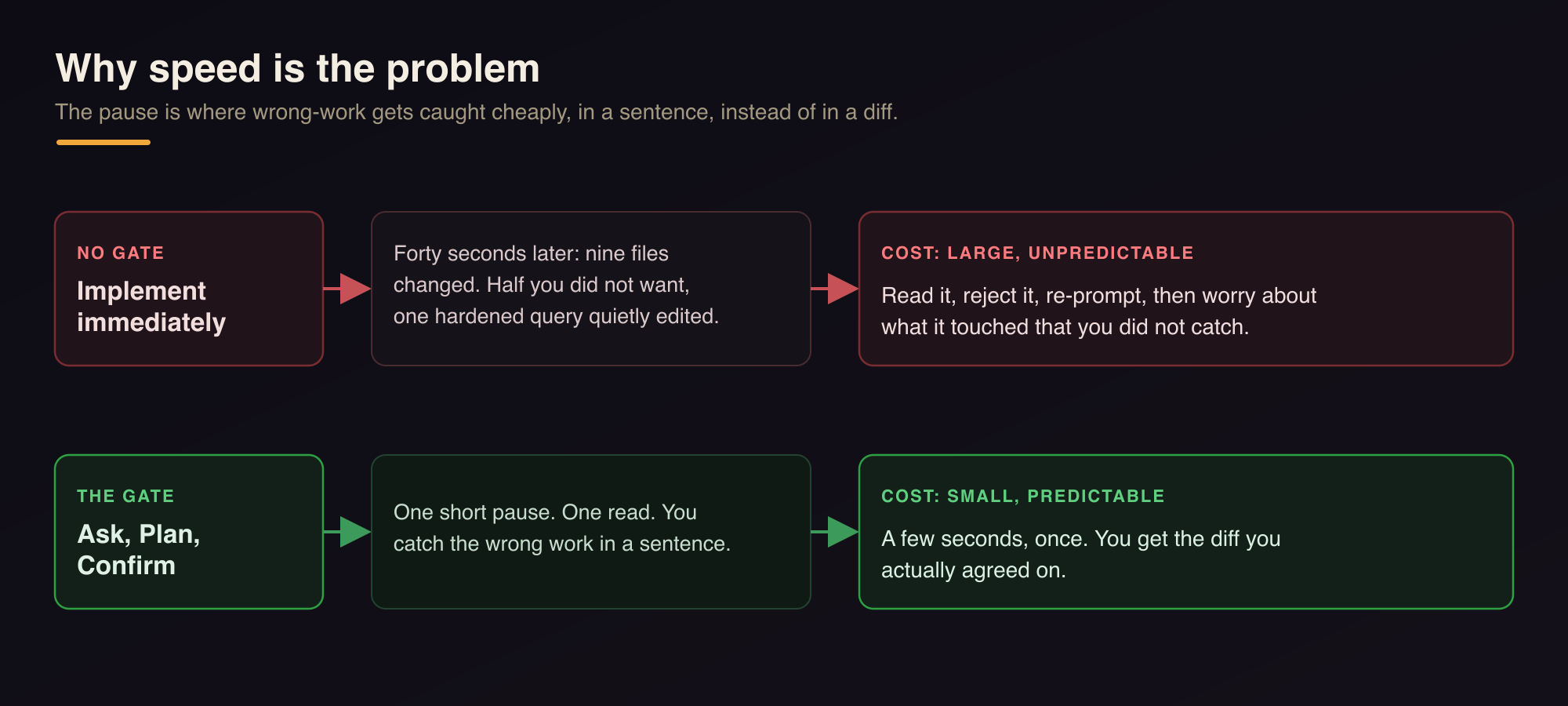
The scariest thing about a genuinely capable coding agent is how quickly it commits. You type two sentences, and forty seconds later there are changes across nine files, half of which you did not want and one of which quietly changed a query you spent a week hardening. The agent was not wrong about how to implement the thing. It was wrong about what the thing was, and it never stopped to check.
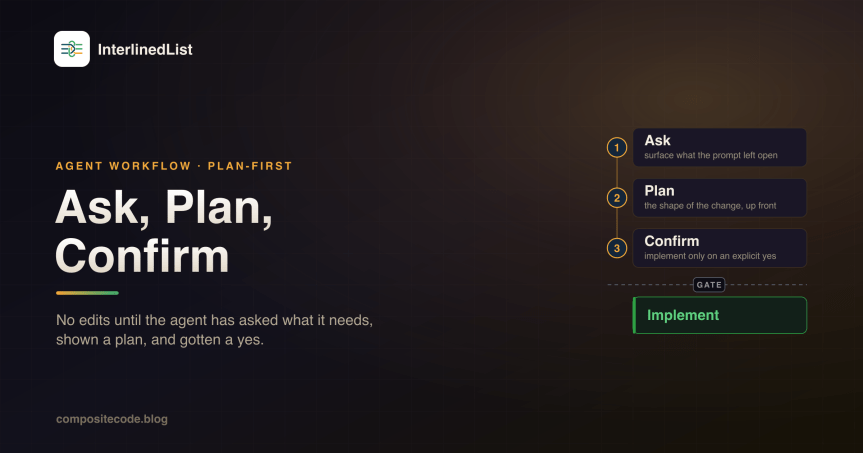
I have watched this happen enough times that I stopped treating it as a prompting problem and started treating it as a workflow problem. A better one-shot prompt is not the fix. A gate is: the agent is not allowed to edit files until it has asked what it needs to ask, shown me a plan, and gotten a yes.
Why speed is the problem
Human engineers have a built-in pause. Before a senior developer touches your codebase they ask a couple of questions, sketch the approach, maybe drop a comment on the ticket. That pause is where the wrong-work gets caught, cheaply, in a sentence, instead of expensively, in a diff you have to read and reject.
Agents removed the pause. That is most of their value and most of their danger in the same motion. An agent that implements immediately optimizes for the wrong thing: it treats “produce a diff” as the goal, when the goal was “produce the diff we agreed on.” The gap between those two is where the deleted work and the silent scope creep live.
That gap is not a knowledge problem. The agent knows how to write the code. It just never checked that it was writing the right code.
The same task, gated and ungated. Skipping the pause trades a small, predictable cost for a large, unpredictable one.
So I gave the pause back, deliberately, as a standing instruction on every agent in the InterlinedList repo.
The three beats
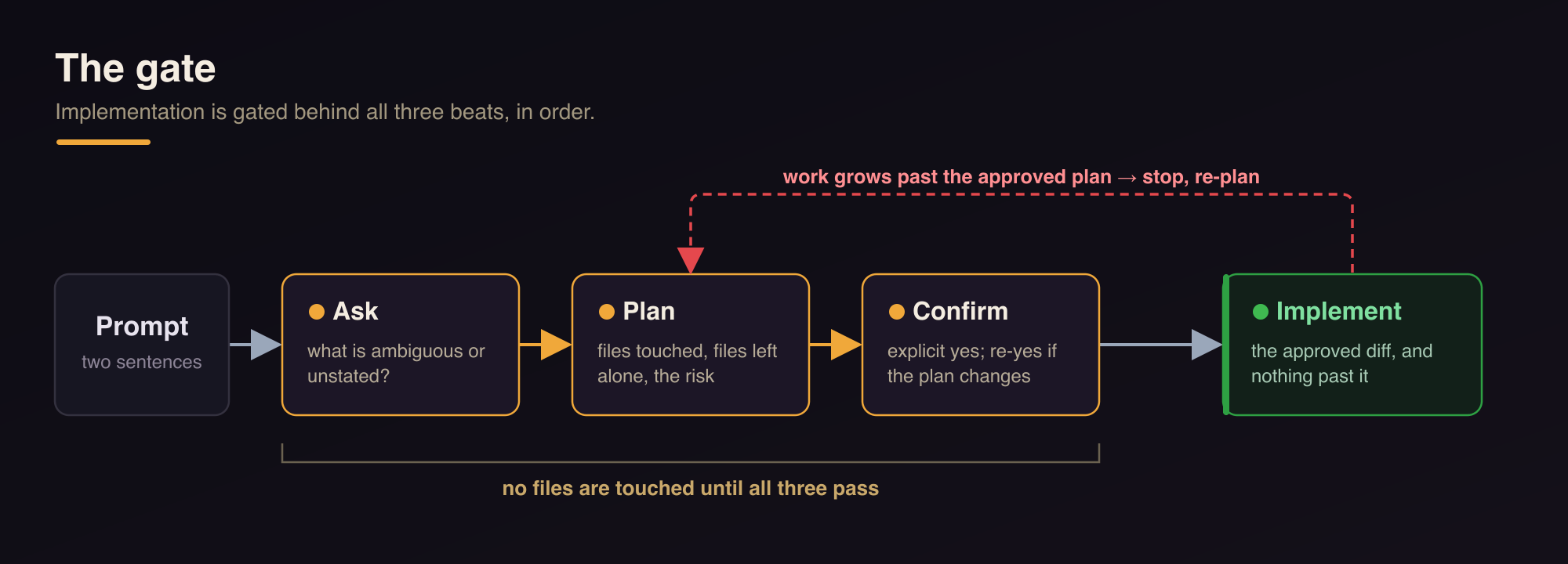
The workflow is written down in .claude/workflows/plan-first.md and every agent links to it. It is three beats, in order, and implementation is gated behind all three.
The three beats, in order. Nothing is edited until all three pass, and work that grows past the approved plan loops back to re-plan rather than quietly expanding.
Ask. Surface what the prompt left open before committing to an approach. Ambiguous scope, unstated edge cases, a product decision hiding inside a technical request, whether a feature should be tier-gated. The migrations agent asks about column types and nullability and whether anything destructive is implied. The Next.js agent asks which surfaces are in and out. The rule has an escape hatch, because asking three questions about a one-line copy fix is its own kind of annoying: skip the questions only when the request is genuinely unambiguous and low-risk. When in doubt, ask. A pointed question is cheaper than a wrong build every single time.
Plan. Before touching files, lay out the shape of the change: the files and routes and components you will touch, the ones you will deliberately leave alone, the approach, any migration (additive, always), the tests the change needs, and anything risky. In this repo “risky” has a specific meaning: auth, IDOR, subscription gating, SSRF, secret handling, anything destructive or hard to reverse. The plan is a decision aid, not a document. It should be short enough to read in one breath and specific enough that approving it means something.
Confirm. Implement only after an explicit yes. If the plan changes in the back-and-forth, restate the revised version and get the yes again. And the part that actually matters over a long session: approval is scoped to the plan that was approved. If the work grows past it, the agent stops and re-plans instead of quietly expanding. That last clause is what keeps a “small fix” from turning into an afternoon of changes I never signed off on.
What it looks like per agent
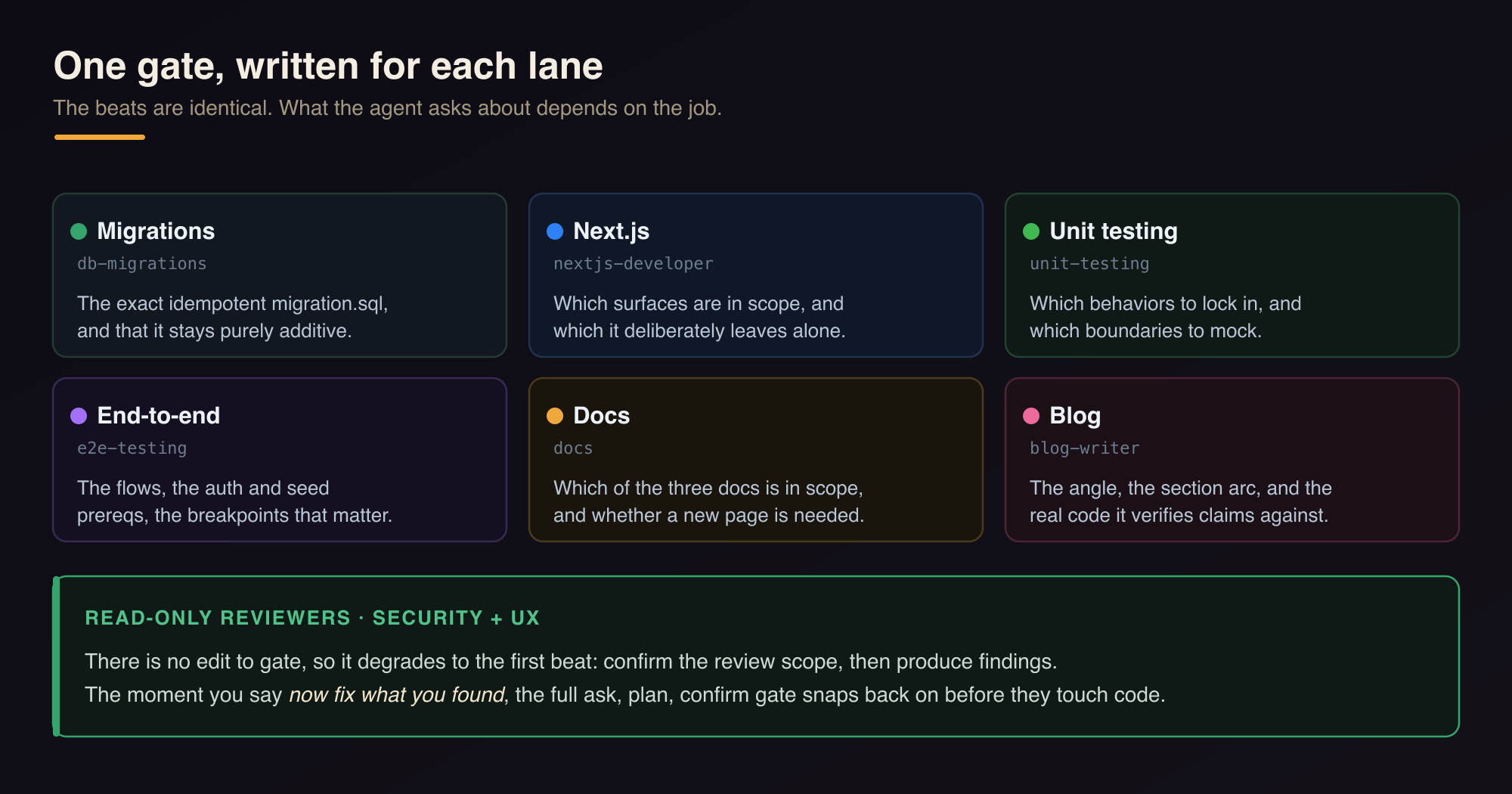
I did not want one generic paragraph pasted eight times. The gate is the same, but what you ask about depends on the job, so each agent got the beats written for its lane.
One gate, written for each lane. The two read-only reviewers pick the full gate back up the moment they move from finding to fixing.
The migrations agent plans the exact idempotent migration.sql and confirms it is purely additive before it applies anything. The unit-testing agent asks which behaviors to lock in and which boundaries to mock, then lists the cases each test file will assert. The e2e agent names the flows, the auth and seed prerequisites, and the breakpoints that matter. The docs agent confirms which of the three docs is in scope and whether a new page is needed. The blog agent (yes, this one) settles the angle and the section arc and which real code it will verify claims against before drafting a word.
The two read-only reviewers are the interesting edge. Security and UX do not implement, so there is no edit to gate. For them the gate degrades to its first beat: confirm the review scope if it is ambiguous (which routes, how deep, which breakpoints), then produce findings. But the moment the user says “now fix what you found,” they are implementers, and the full ask-plan-confirm gate snaps back on before they touch code. The reviewer does not get to slide from “here is a finding” into “and I fixed it” without crossing the same line everyone else crosses.
The obvious objection
This is slower. That is the point, and it is also not as true as it sounds. The plan step costs you a few seconds and one read. Rejecting a forty-second nine-file diff that went the wrong direction costs you the read plus the reject plus the re-prompt plus the nagging worry about what it touched that you did not catch. The gate front-loads a small, predictable cost to avoid a larger, unpredictable one. Over a day of handoffs it is not close.
It also composes with the other habit I built into these agents: every one of them does its work in an isolated git worktree, on its own branch, torn down when the task lands. Plan first, then do the approved work in a sandbox that cannot collide with anyone else. The worktree contains the blast radius. The plan makes sure there is not supposed to be a blast in the first place.
The pause was always the expensive part of good engineering. Worth teaching the machines to keep it.
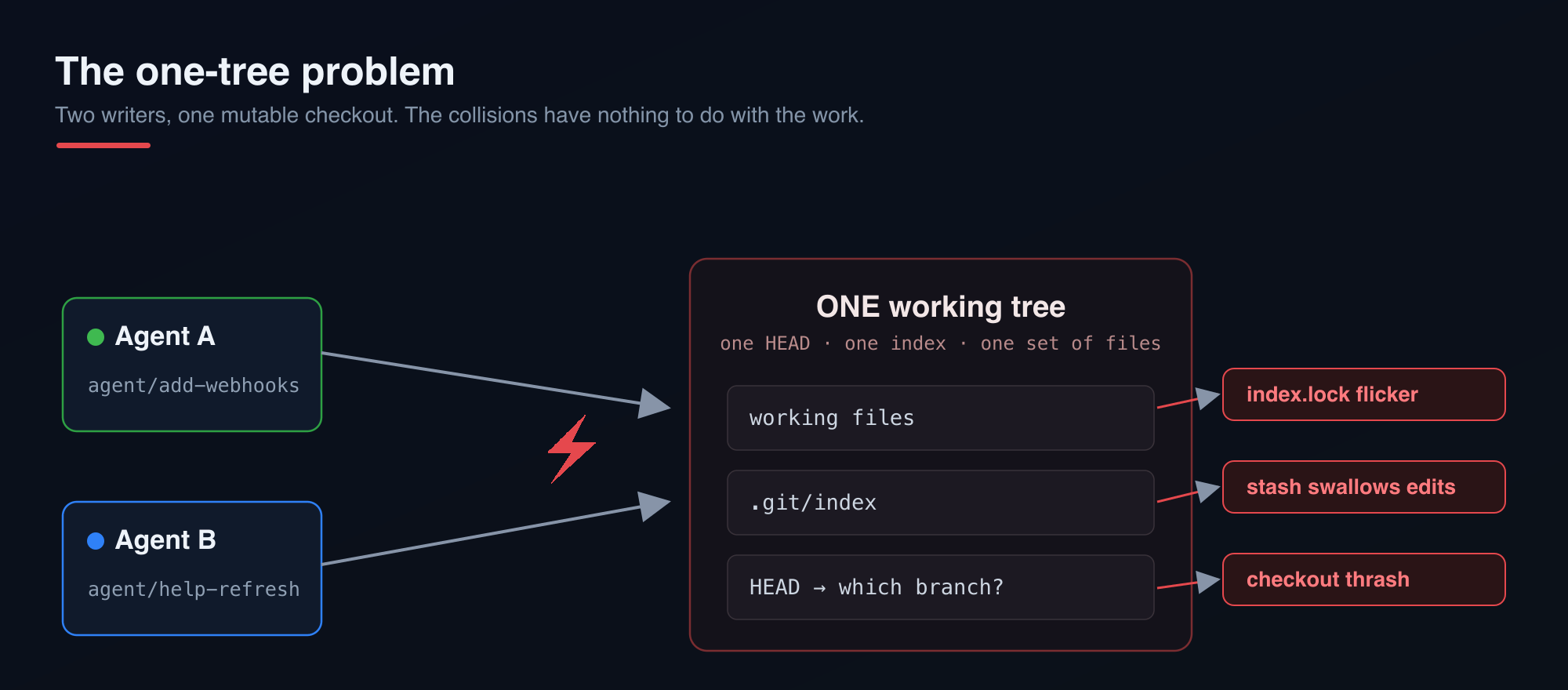
Run two coding agents against a single working tree and they will fight. One is halfway through editing app/api/messages/route.ts while the other checks out a different branch underneath it. The index lock flickers. A git stash from one session swallows the other’s uncommitted work. I have lost real edits this way, and every time the root cause was the same: one working tree, one HEAD, two writers.
The InterlinedList repo already had matching agents for the jobs I hand off most: a Next.js implementer, a migrations specialist, unit and e2e testers, a docs writer, security and UX reviewers. They are good at their lanes. What they were missing was a lane in the literal sense. They all drove on one road.
I found the pattern I wanted written up in Augment’s guide to git worktrees for parallel AI execution, and it maps almost one to one onto how I already think about agents. This is the writeup of what I built on top of it for this repo: the directory convention, the seven scripts that manage the lifecycle, and the wiring that makes every agent use them without being reminded.
The one-tree problem
A normal clone gives you a single working directory backed by one .git. That is fine for one person doing one thing. The moment you parallelize, the shared mutable state (the working files, the index, the current branch) becomes the bottleneck. You cannot have the migrations agent on agent/add-webhooks and the docs agent on agent/help-refresh at the same instant, because “the branch” is a property of the whole checkout.
Two writers, one mutable checkout. The collisions have nothing to do with the work: an index lock flickers, a git stash swallows the other session’s edits, HEAD thrashes between branches.
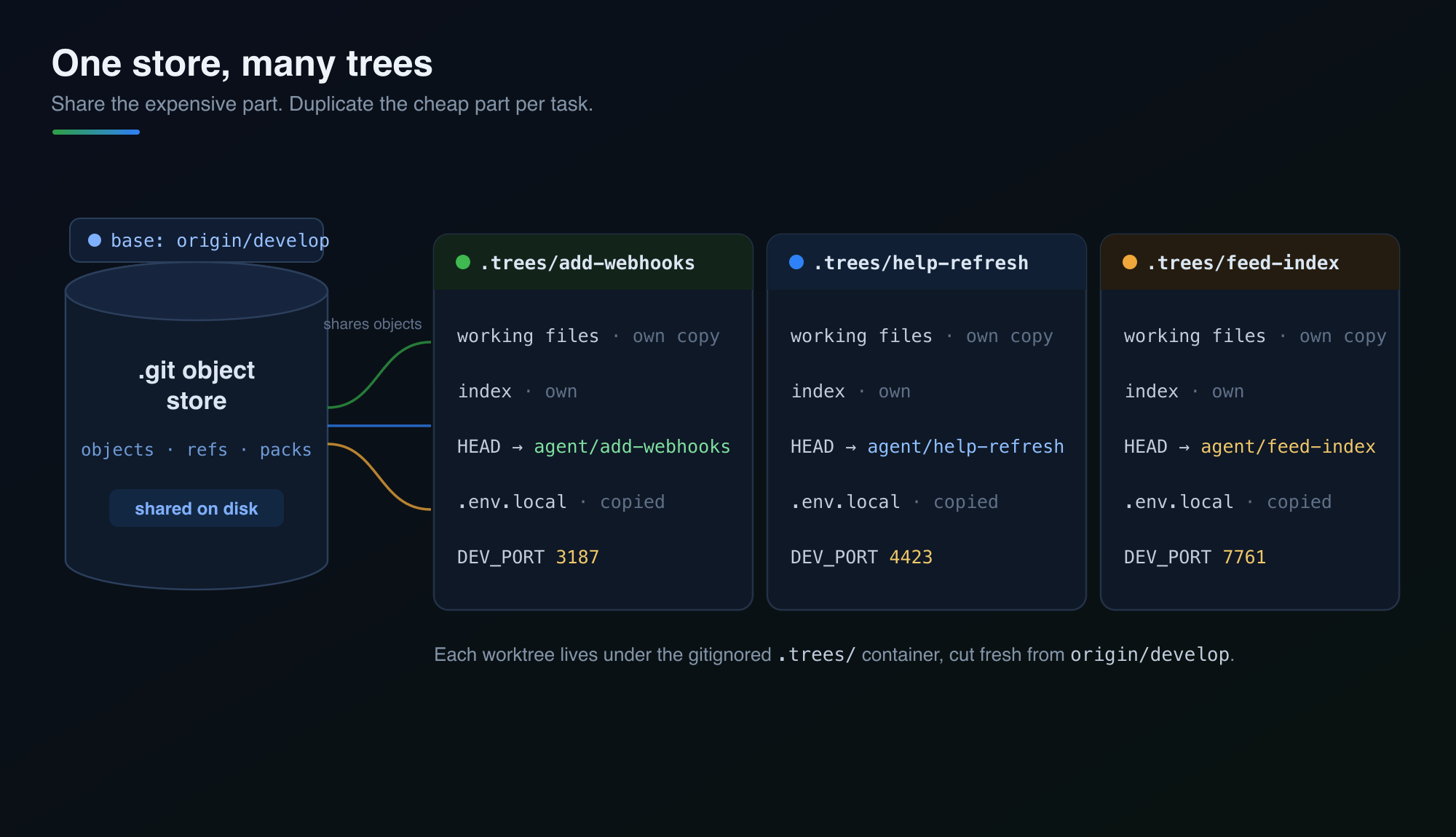
Git solved this in 2015 with git worktree. A worktree is a second (third, fourth) working directory attached to the same repository. Each one has its own files, its own index, and its own checked-out branch, while sharing one object store on disk. The object store is the expensive part, so you share it. A directory of files is cheap, so you duplicate it per task. That is exactly the tradeoff you want for parallel agents.
Share the expensive part, duplicate the cheap part. The object store lives on disk once; the working files, the index, the checked-out branch, and even the dev-server port are private to each worktree.
The convention
Every agent works in .trees/<task-id> on a branch named agent/<task-id>, cut from origin/develop (this repo integrates on develop, not main). So a task called add-list-webhooks lives at .trees/add-list-webhooks on branch agent/add-list-webhooks. The directory name and the branch name always agree because both are derived from the same sanitized slug.
The .trees/ container is gitignored. Worktrees are workspace, not history:
# .gitignore
# Agent worktrees (see scripts/worktrees/)
.trees/
That single ignore line is the whole footprint the pattern leaves in the tracked tree. Everything else is scripts and instructions.
The scripts
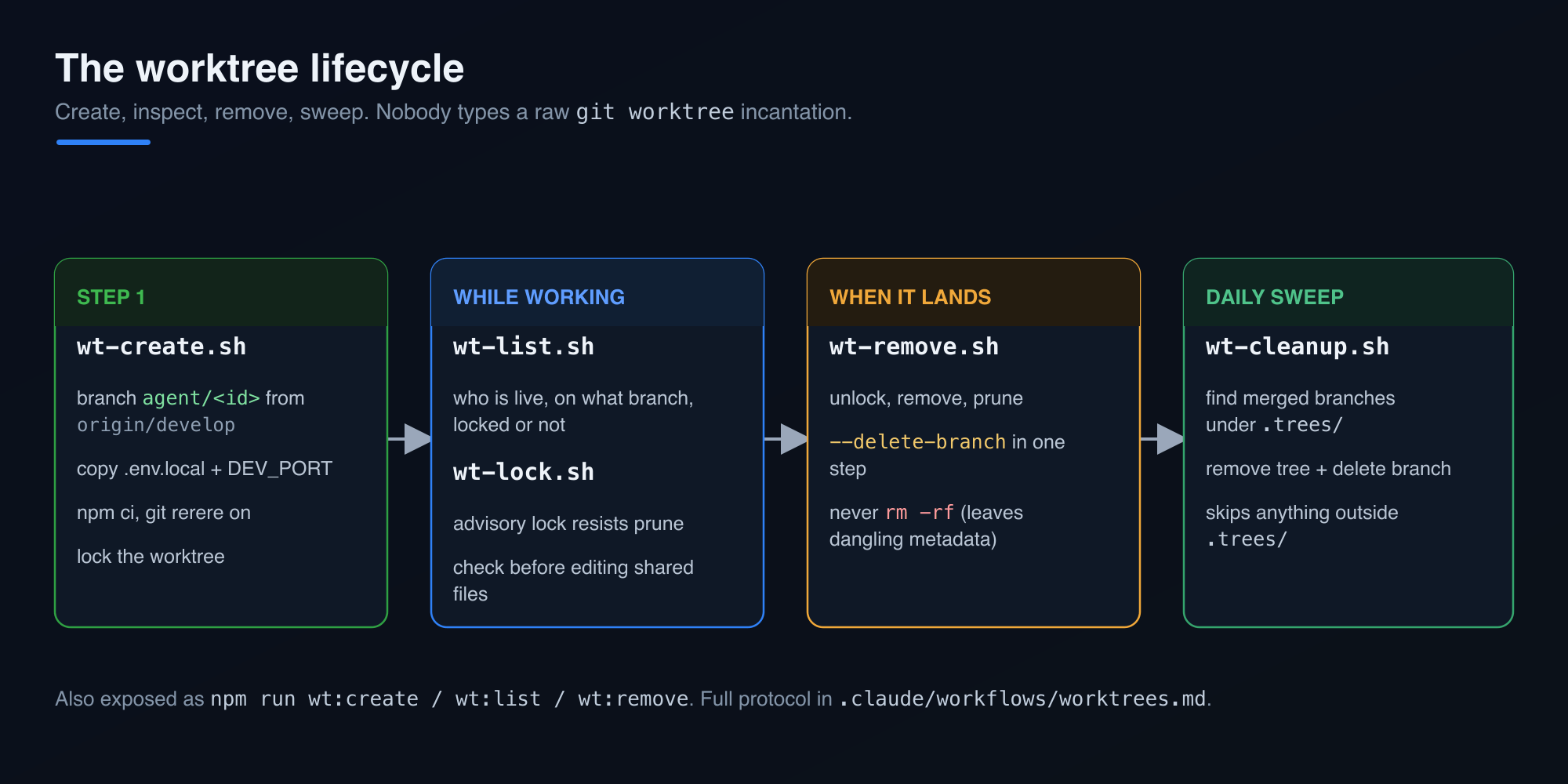
I did not want agents (or me) typing raw git worktree incantations and getting the branch name wrong, or forgetting to copy .env.local, or leaving stale metadata behind. So the lifecycle lives in scripts/worktrees/ as a small set of focused shell scripts. Here is every one of them.
The whole lifecycle before the per-script detail. Create, inspect while working, remove when it lands, sweep the merged trees on a schedule.
_lib.sh is the shared library the others source. It holds the functions that keep conventions consistent: wt_repo_root resolves the primary checkout even when you call it from inside a linked worktree (it reads git rev-parse --git-common-dir and walks up), wt_sanitize lowercases a task id and strips it to [a-z0-9._-], wt_resolve_base fetches and prefers origin/<base> over a local branch, wt_port_for hashes a branch name into a stable dev port, and wt_is_locked reads the porcelain worktree list to check lock state. Nothing in it is clever. It exists so the clever bits are written once.
wt-create.sh <task-id> [base] is the one agents call first. It creates the worktree and makes it ready to work in, in one shot:
scripts/worktrees/wt-create.sh add-list-webhooks
Under the hood it resolves the base ref (default develop), ensures .trees/ is in .gitignore, turns on git rerere so repeated conflict resolutions replay across parallel merges, runs git worktree add -b agent/<slug> .trees/<slug> origin/<base>, copies the root .env.local into the worktree, appends a deterministic DEV_PORT derived from the branch name, runs npm ci --prefer-offline, and finally locks the worktree so other sessions can see it is in use. Flags let you opt out where it makes sense: --no-install skips the dependency install for a quick plumbing check, --no-lock leaves it unlocked, and --baseline runs the test suite right after setup so a green baseline proves any later failure came from the agent’s change rather than a pre-existing break.
The port assignment is worth a sentence. Two agents both running next dev on 3000 is another collision, a quieter one. wt_port_for runs the branch name through cksum and maps it into the 3100 to 9998 range, so each worktree gets a stable, distinct port written into its own .env.local. Start the server with npm run dev -- -p "$DEV_PORT" and two dev servers coexist.
wt-list.sh answers “what is running right now.” It prunes stale metadata, then prints one row per worktree with path, branch, lock state, and short HEAD:
Before an agent touches a shared file, it can look here and see who else is holding what. Git will not warn you about two branches editing the same file, so this list plus discipline about non-overlapping file domains is the actual safety mechanism.
wt-lock.sh <task-id> [reason] and wt-unlock.sh <task-id> are thin wrappers over git worktree lock/unlock. A lock is advisory: it resists prune and move, and it is the signal in wt-list.sh that says “an agent is live in here, do not reap this.”
wt-remove.sh <task-id> is the teardown. It unlocks if needed, runs git worktree remove, and prunes. This matters more than it looks: deleting a worktree with rm -rf leaves dangling metadata in .git/worktrees/ that haunts you until the next prune. The script never does that. --force discards uncommitted changes on purpose, and --delete-branch drops agent/<task-id> in the same step when the work has landed.
wt-cleanup.sh [base] is the bulk sweep. It walks every worktree physically under .trees/, and for each one whose branch is already an ancestor of origin/develop (in other words, merged), it removes the worktree and deletes the branch. It deliberately skips anything outside .trees/, so the primary checkout and any sibling worktrees I keep elsewhere on disk are never touched. This is the script you point a daily cron or a post-merge hook at.
Each of these is also exposed as an npm script, so npm run wt:create -- add-list-webhooks, npm run wt:list, and npm run wt:remove -- add-list-webhooks all work if you prefer that entry point. There is a scripts/worktrees/README.md documenting the whole set alongside the code.
Wiring it into the agents
Scripts nobody runs are decoration. The point was to make every agent reach for a worktree by default, so I added the instruction in three places at three levels of specificity.
At the top, CLAUDE.md now states the standing rule: every agent works in an isolated worktree, torn down with the lifecycle scripts. That is the repo-wide contract.
In the middle, two shared protocol docs under .claude/workflows/ hold the full detail: worktrees.md spells out the create-work-remove lifecycle, the boundaries (shared object store, non-overlapping files, and the important caveat that the database is shared even though the files are not), and plan-first.md covers the companion habit I wrote about separately. Every agent and skill links to these rather than repeating them.
At the leaf, each of the eight agent definitions in .claude/agents/ got a “Work in an isolated git worktree (required)” section written for its job. The implementers (Next.js, migrations, tests, docs, blog) get the full create-work-remove flow. The two read-only reviewers (security, UX) get a variant that tells them to cd into the worktree under review and read its diff, and explicitly not to create, lock, or remove anything. The migrations agent gets an extra warning in bold, because the worktree isolates schema.prisma and the migration files but not the Postgres instance: db:migrate still hits localhost and db:migrate:deploy still hits production from any worktree. That is the one place the isolation is a lie, and the agent needs to know it.
The five paired skills in .claude/skills/ (the ones that back the implementer agents) got a short “Worktree-first, plan-first” block near the top pointing at the same protocol docs, so whether the work comes in through the agent or the skill, the instruction is there.
Proving it works
I ran the whole lifecycle before committing any of it. Create a worktree from develop, confirm it is locked and has its port, unlock and re-lock it, remove it with the branch, and verify the cleanup pass leaves the sibling worktrees alone:
Every step did what it said, the .gitignore guard refused to duplicate the .trees/ line it found already present, and the sibling worktree I keep for feed-perf work was never in scope for cleanup. That last part was the thing I most wanted to confirm, because a cleanup script that reaches outside its sandbox is worse than no cleanup script.
Where agents still get confused
Isolating the filesystem fixes the filesystem. It does nothing about the fact that the work itself overlaps, and there are a handful of ways an agent still gets lost.
The database is one instance, and every worktree writes to it. I flagged this to the migrations agent in bold, but it deserves more than a warning. If the migrations agent adds a column on agent/add-webhooks, that column now exists in the same localhost Postgres every other worktree points at. The docs agent three trees over never sees the changed schema.prisma, yet its queries hit the mutated database anyway. Additive-only migrations keep this survivable most of the time, since an extra column nobody reads is harmless. But the moment two agents touch the same table, or one runs db:migrate:deploy and reaches production from what looked like a sandbox, the isolation is a fiction. The files are private. The database is not.
Green in isolation, red on merge. This is the one that bites. Agent A changes a function signature in lib/lists/queries.ts. Agent B, on its own branch, calls that function from a route it owns. Their files never overlap, so wt-list.sh shows no conflict and git stays quiet. Both test suites pass, because A’s worktree still holds B’s old caller and B’s worktree still holds A’s old signature. It’s all green right up until both branches land on develop, and then the integration is broken in a way neither agent could see from inside its own tree. Worktrees convert a loud, immediate collision into a quiet one that surfaces later. Often a fair trade, but a trade.
Stale base drift. Every worktree is cut from origin/develop the moment it’s created. Agents aren’t always short-lived. Let one run for a few hours while three others merge back, and it’s now building on a develop that no longer exists. It will reintroduce a helper that got deleted upstream, or write against an API another agent already reshaped. The worktree has no idea the ground moved under it. Nothing in the create-work-remove loop forces a re-fetch, so a long-running agent drifts out of date without noticing.
“Does this already exist?” stops having one answer. With five branches in flight, whether feature X is “already built” depends on which tree you grep. An agent that checks the primary checkout won’t see work-in-progress on another branch, and it will happily build a second copy. I’ve watched two sessions independently implement overlapping halves of the same feature, each sure it was first, because neither branch was visible to the other and neither said up front what it was about to touch. wt-list.sh tells you which branches exist. It says nothing about what each one intends to change.
The lock is a suggestion.wt-lock resists prune and move, and it flags a tree as live in the list, but it will not stop another agent from opening the same file on its own branch and editing away. The real guard against two agents clobbering one file is the up-front decomposition plus the discipline to run wt-list.sh and honor what it shows. An agent that skips the check has no seatbelt, just the shape of one.
Abandoned trees pile up.wt-cleanup.sh only sweeps branches already merged into develop. A worktree from a crashed or cancelled session is unmerged, still locked, and invisible to the sweep. It sits on disk with a full node_modules until someone removes it by hand. And an agent resuming a task can trip over a half-finished tree from an earlier run and read its stale state as current work.
Losing the current directory. The workflow says cd .trees/<task-id> and do everything there. Shell state doesn’t always survive between tool calls, and an absolute path into the primary checkout looks identical to one into a worktree. An agent that loses track of where it is can read the main checkout’s copy of a file, reason about it as though it were its branch’s version, and edit the wrong tree. The isolation holds only as long as the agent keeps its bearings.
What this buys
The honest version: worktrees do not make independent tasks independent. If two agents both need to edit the same route, isolating their filesystems just delays the merge conflict, it does not prevent it. The decomposition still has to be real. What the pattern removes is the accidental collision, the kind that has nothing to do with the work and everything to do with sharing one mutable checkout. Those were most of my pain, and now they are gone by construction.
Advantages and disadvantages
Advantages
Accidental collisions disappear. Each agent gets its own files, index, and HEAD, so index-lock flicker, a stray git stash eating another session’s edits, and checkout thrash stop happening.
Every task lands on its own agent/<task-id> branch, which keeps review and merge clean and stops one task’s half-finished mess from bleeding into another’s diff.
The object store is shared, so the costly part of the repo lives on disk once and spinning up another tree is cheap.
Each worktree gets a deterministic DEV_PORT, so several next dev servers run side by side instead of fighting over 3000.
The lifecycle is scripted and wired into every agent definition, so the right setup and teardown happen without anyone remembering the incantation.
git rerere is on by default, so a conflict you resolve once replays across the parallel merges that hit it again.
Cleanup is fenced to .trees/, so the bulk sweep never reaches the primary checkout or the sibling worktrees I keep elsewhere.
Disadvantages
The database isn’t isolated, and neither is anything else global (production through db:migrate:deploy, OAuth apps, third-party rate limits). File isolation quietly implies an isolation that isn’t there.
Overlapping edits on separate branches turn into silent, deferred conflicts and semantic breakage that pass every isolated test and only show up at integration.
A long-running worktree drifts from a moving develop, and nothing in the loop forces the re-fetch that would catch it up.
Locks are advisory, so the actual protection against two agents editing one file is decomposition plus discipline, not anything git enforces.
With several branches live, “does this already exist” has no single answer, and agents duplicate each other’s work when branches can’t see one another.
Every worktree carries a full node_modules, so disk use and npm ci time multiply with each active task.
Crashed or abandoned sessions leave locked, unmerged trees that the merged-only cleanup won’t reap, so someone clears them by hand.
Coordination is still manual: the tooling shows which branches exist, not which files each agent means to touch.
The next habit I want in every agent sits upstream of all of this: stop and plan before touching a single file. That one is worth its own post.
More solutions to the confusion above are coming in the next few posts. Subscribe so you don’t miss ’em: drop your email into the box just below this post, or grab the RSS feed.
This video features me, a Principal Software Engineer, discussing the impact of AI on software development, the risks of “vibe coding,” and the necessary shifts in engineering practices. Adron argues that traditional manual coding is becoming obsolete and that developers must adapt to a new paradigm defined by systems thinking and AI orchestration.
Key Takeaways:
The Dangers of “Vibe Coding”: Adron defines “vibe coding” as the practice of relying on AI to generate code without a deep understanding of the system (0:08:31). This often leads to unmaintainable, “disposable” software—a phenomenon he calls the shinification of software—which can cause significant production issues when systems fail (0:00:46, 0:08:31).
Managing AI Agents: To maintain code quality, developers must:
Rein in Scope: Avoid open-ended prompts; instead, provide specific, well-defined architectural plans to AI agents (0:05:13, 0:06:01).
Diff Discipline: Enforce hard limits on diff sizes (e.g., aiming for ~50 lines) to ensure human reviewers can feasibly audit changes (0:52:37, 0:55:00).
Human Gatekeeping: Keep humans as the final gatekeepers for production deployments to ensure security and reliability (0:16:50, 0:57:29).
The Evolution of the Developer Role: The junior pipeline is changing; instead of focusing on syntax or pixel-pushing, future developers should act as systemic architects who understand how to orchestrate AI tools and manage complex workflows (0:24:05, 0:26:05).
The Industry Reckoning: As VC-subsidized AI adoption faces future economic corrections, companies will need to prioritize efficiency, energy production, and true orchestration over simply generating massive amounts of code (1:02:41, 1:05:00).
Future Predictions: Adron predicts that AI will eventually develop its own programming language optimized for machine-to-machine communication, further distancing development from manual human typing (1:09:48).
In this episode, you’ll learn:
Why writing code manually means you are already too far behind.
How to manage the six specific types of AI code changes.
The reason Diff Discipline is the only way to survive vibe coding.
Time Sliced Segments
(03:14) Why the junior developer pipeline is imploding
(05:13) How to reign in agent scope for better results
A Principal Engineer is a senior software engineer who is responsible for the design and implementation of the company’s software architecture. They are also responsible for the technical direction of the company, or the team(s) they work with and the development of the company’s (or team(s)) software engineers.
Context: What is the Agentic Era?
The Agentic Era is a new era of software development where software is built by agents. Agents are software that can learn, reason, and act (to a degree). They are able to perform tasks autonomously (theoretically) and are able to learn from their environment.
Where I Am
Over the course of the last few years, we have seen the rise of AI agents. These agents are able to perform tasks autonomously and are able to learn from their environment. They are able to perform tasks that are typically performed by humans, such as coding, design, and problem solving. This of course, has dramatically changed the way we build software already.
What I’ve written here so far is an observation of the reality we live in. I’m not trying to make a judgement call or say agentic tooling is good or bad, just merely setting the baseline of where we are. Whether you love AI Tooling or hate it or are indifferent to it, it’s here. No matter how much we discover it makes you stupid and lazy over time or other horrid things, the reality is that it is here and it is causing significant changes.
My Observations & Experience as a Principal Engineer
My experience so far, as a principal engineer – or one who does the work of a principal engineer – regardless of role. Is that I’ve started doing more debuging, troubleshooting, and problem solving than any actual coding. Not to say I am not coding, I’m doing a ton of that, but just as much I need to bring my experience and knowledge into play to ensure the debugging, troubleshooting, and problems solving gets answers in a timely way. However, I have agentic systems build things for me that previously I’d have hired junior or mid level engineers to do. But the core of what a princpal engineer does is almost the same as it was 5 or 10 years ago, it just involves agentic systems taking care of probably 50% of the code I’d have hired juniors or mid-level engineers to knock out, that work is gone.
What does this change mean overall? My personal experience lately comes down to two specific things.
We are now able to build software faster and cheaper than the before era. Cheaper also meaning with less staff for longer stretches of time.
We are now able to build software that is more complex and more intelligent at a rate we couldn’t before.
Does it just help with these? No. Agentic systems can help us in many other ways too, this is just the specific two things I’ve seen occur. Let me dig into this more deeply.
One Scenario
In one scenario I was in, working on some project work I found the team used the tooling to effectively identify, debug, and resolve issues at a dramatically faster pace than these issues could have been dealt with before. The solutions were also more robust because of the skill and knowledge of the developers using the AI tooling. If it had been less experienced developers this could have created a catastrophic development debt that wouldn’t be recoverable from.
Which leads presciently into the next scenario.
Another Scenario
In another scenario I found myself in, as an observer, it wasn’t the particular project I was working on. I watched as a team started to build a greenfield project. In most scenarios you would think, if familiar with agentic coding, that this is the perfect scenario for agentic coding. However this team lacked the experience with the stack and the domain. They then found themselves building out a prototype, trying to take that and continue with it as a deployed production system. Not an entirely odd or shocking scenario.
But with the use of the agentic systems, skipping over key learning moments and not knowing the system they had built put the team in an unprepared situation upon the first issues that came up. Within weeks of deployment they realized their lack of familiarity with what they built had effectively made them unable to troubleshoot problems effectively.
It was literally the opposite of the first scenario. This scenario quickly became catastrophic and the project got abandoned, somewhat unceremoniously, and the team didn’t particularly learn good lessons from the experience. Sadly, since it should have been obvious what the overall issue was, it seemed to be more blamed on the agentic tooling. The fact is, the team should have realized they need to spend substantial time ensuring they read the generated docs, the generated code, and understood what they’d built. Instead the assumption was the agentic system would be able to keep up with all those aspects.
In the end, it failed.
In Closing, Observations at This Point in Time
First observation among everything is that agentic tooling when used effectively is a massive game changer. A Principal Engineer, setting precedent and direction, with 1-2 teams can easily take on what 2-4 teams could do previously. But the key to it is effective use and more experienced engineers (i.e. Principal and a few seniors sprinkled in) that can ensure bugs don’t become roadblocks, and that the agentic tooling is being wielded properly.
The second bit observation is that if a team isn’t going to use agentic tooling effectively, it’s going to be a massive detriment to the team. It’s going to slow down the team, it’s going to create a lot of technical debt, and very likely it could derail the project to the point of failure.
For now, that’s just a few of my many observations. More to come and maybe some paired agentic code slinging! In the meantime, happy thrashing code.

You must be logged in to post a comment.