A collection of notes and details. There’s plenty of details and docs out there, which I’ll reference a few below to get started with Cassandra. The goal with these notes is to provide a kind of summarized punch list of items to quickly get started around Cassandra/Datastax Enterprise 6 (DSE6). I’ll have a number of additional pieces coming real soon, as I’ve got some geeky experiments and related surprise implementations I’m putting together in the very near future. Let’s just say there will likely be Lego, trains, and many nodes among other fascinating elements coming together to make it happen! Enjoy the start…
The Big Details
- Who – Avinash Lakshman (@hedvigeng) and Prashant Malik (@pmalik) originally developed Cassandra at Facebook for inbox search.
 What – Apache Cassandra is a highly scalable, high-performance distributed database built with the ability to handle large amounts of structured data decentralized across many servers. In service of that goal Cassandra provides a highly available system without a single point of failure.
- Where – Apache Cassandra can be found on the Apache Cassandra Site and the code in the Cassandra Github Repo.
- When – Cassandra was released as open source by Facebook in 2008, and became an Apache top-level project in February of 2010.
- Why – When you want no fixed schema, massive scale, huge storage capability options, eventually consistent, fault-tolerant, dynamic/elastic scalability, fast linear-scale performance, always on highly available, and related features.
Distributed Databases
Getting Started, Installing, Configuration, Setup, & Start
CQL – Cassandra Query Language
Intro & Architecture of Cassandra References
This is merely the beginning of the blogging, projects, and notes, if you’d like to bookmark where I’ll be linking all of my Datastax + Cassandra notes, check out my Cassandra root documentation & links page.
 Ashutosh Sanzgiri (@sanzgiri) is a Data Scientist at AppNexus, the world’s largest independent Online Advertising (Ad Tech) company. I develop algorithms for machine learning products and services that help digital publishers optimize the monetization of their inventory on the AppNexus platform.
Ashutosh has a diverse educational and career background. He’s attained a Bachelor’s degree in Engineering Physics from the Indian Institute of Technology, Mumbai, a Ph.D. in Particle Physics from Texas A&M University and he’s conducted Post-Doctoral research in Nuclear Physics at Yale University. In addition to these achievements Ashutosh also has a certificate in Computational Finance and an MBA from the Oregon Health & Sciences University.
Prior to joining AppNexus, Ashutosh has held positions in Embedded Software Development, Agile Project Management, Program Management and Technical Leadership at Tektronix, Xerox, Grass Valley and Nike.
Scaling Machine Learning (ML) at your organization means increasing ML knowledge beyond the Data Science (DS) department. Several companies have Data / ML literacy strategies in place, usually through an internal data science university or a formal training program. At AppNexus, we’ve been experimenting with different ways to expand the use of ML in our products and services and share responsibility for its evaluation. An internal contest adds a competitive element, and makes the learning process more fun. It can engage people to work on a problem that’s important to the company instead of working on generic examples (e.g. “cat vs dog” classification), and gives contestants familiarity with the tools used by the DS team.
In this talk, Ashutosh will present the experience of conducting a “Kaggle-style” internal DS contest at AppNexus. he’ll discuss our motivations for doing it and how we went about it. Then he’ll share the tools we developed to host the contest. The hope being you too will find inspiration to try something in your organization!
 BigML was founded in January 2011 in Corvallis, Oregon with the mission of making Machine Learning beautifully simple for everyone. We pioneered Machine Learning as a Service (MLaaS), creating our platform that effectively lowers the barriers of entry to help organizations of all industries and sizes to adopt Machine Learning.
As a local company with a mission in complete alignment with that of the conference, BigML would be delighted to partake in this first edition of ML4ALL.
“So you’ve heard of Machine Learning and are eager to make data driven decisions, but don’t know where to start? The first step is not to read all the latest and greatest research in artificial intelligence, but rather to focus on the data you have and the decisions you want to make. Fortunately, this is easier than ever because platforms like BigML have commoditized Machine Learning, providing a consistent abstraction making it simple to solve use cases across industries, no Ph.D.s required.
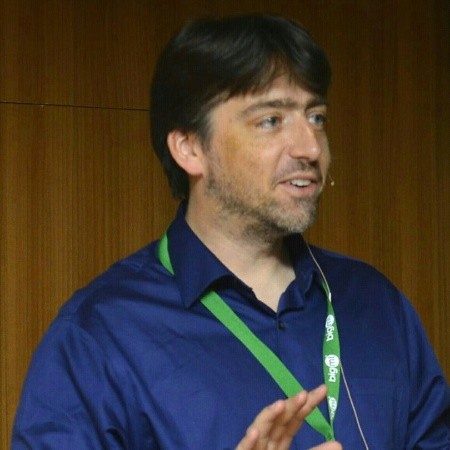
As a practical, jump-start into Machine Learning, Poul Petersen, CIO of BigML, will demonstrate how to build a housing recommender system. In just 30 minutes, he will cover a blend of foundational Machine Learning techniques like classification, anomaly detection, clustering, association discovery and topic modeling to create an end-to-end predictive application. More importantly, using the availability of an API will make it easy to put this model into production, on stage, complete with a voice interface and a GUI. Learn Machine Learning and find a great home – all without paying expensive experts!”
Poul Petersen (@pejpgrep) is the Chief Infrastructure Officer at BigML. An Oregon native, he has an MS degree in Mathematics as well as BS degrees in Mathematics, Physics and Engineering Physics from Oregon State University. With 20 plus years of experience building scalable and fault-tolerant systems in data centers, Poul currently enjoys the benefits of programmatic infrastructure, hacking in python to run BigML with only a laptop and a cloud.
 Anna Widiger (@widiger_anna) has a B.A. degree in Computational Linguistics from University of Tübingen. She’s been doing NLP since her very first programming assignment, specializing in Russian morphology, German syntax, cross-lingual named entity recognition, topic modeling, and grammatical error detection.
Anna describes “Your First NLP Machine Learning Project: Perks and Pitfalls of Unstructured Data” to us. Faced with words instead of numbers, many data scientists prefer to feed words straight from csv files into lists without filtering or transformation, but there is a better way! Text normalization improves the quality of your data for future analysis and increases the accuracy of your machine learning model.
Which text preprocessing steps are necessary and which ones are “nice-to-have” depends on the source of your data and the information you want to extract from it. It’s important to know what goes into the bag of words and what metrics are useful to compare word frequencies in documents. In this hands-on talk, I will show some do’s and don’ts for processing tweets, Yelp reviews, and multilingual news articles using spaCy.
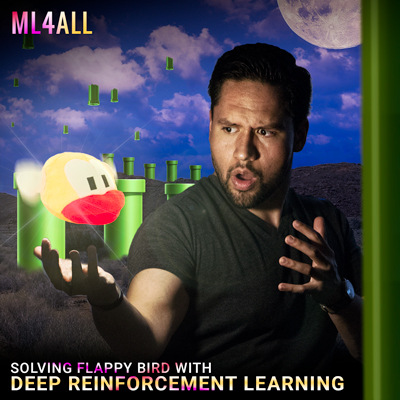 The holy grail of machine learning has always been a “Skynet” type of artificial intelligence that could generally learn anything (artificial general intelligence), and the biggest advancement toward achieving such A.I. is deep reinforcement learning (DRL). The reason for this is DRL’s ability to solve a vast array of problems; its application ranges from learning any video game, to driving autonomous cars, to landing Space-X Falcon 9 rockets. As such, DRL is one of the most exciting fields in machine learning, and will continue to be so for the foreseeable future.
This talk will be a deep dive into the math behind an algorithm which uses DRL to solve the video game Flappy Bird. Additionally the goal of this talk will be such that even the most math-phobic beginner-to-ML will walk away excited about DRL and able to verbalize the central equation to DRL. This will be done in two simple steps. First we will derive the Bellman Equation (classic reinforcement learning), which provides a framework for the algorithm’s decision making process. Second we will use that Bellman Equation to derive a custom loss function, which will drive the training of the algorithm’s deep neural network (deep learning).
To keep things simple during presenting, Kaleo will skip the code snippets but links will be provided where everybody can download the Flappy Bird algorithm’s code, a 20 page paper (written by Kaleo) detailing the algorithm, and a list of resources for further study.
The following is a link to the algorithm code and accompanying paper (PDF), where the math details can be found in section Algorithms and Techniques: https://github.com/06kahao/Improved-Q-Learning-Multi-Environment
Kaleo Ha’o (@06kahao) is a graduate from Udacity’s Machine Learning Engineering program, Kaleo Ha’o is a freelance ML engineer who loves to contribute to Open A.I. research on reinforcement learning.

