Dev Rel Thoughts, Observations, and Ideas

Dev Rel = Developer Relations

First, I’ve got a few observations that I’ve made in the last 6 months since joining DataStax (which I joined ~10 months ago) about a number of things. In this post I’ve detailed some of the thoughts, observations, and ideas I have about many of the aspects, roles, divisions, organizational structure, and related elements of DevRel.

Refining the Definition of Developer Relations

Over the last few months a lot of moments and conversations have come up in regards to DevRel being under the marketing department within an organizational structure. Which has made me revisit the question of, “what is DevRel and what do we do again?” Just asking that question in a free form and open ended way brings up a number of answers and thoughts around what various DevRel teams and even groups within a DevRel team may have as a mission. Let’s break some of this out and just think through the definition. Some of the other groups that DevRel either includes or works very closely with I’ll include too.

Developer Advocates

At the core of DevRel, somewhere, is the notion of advocacy to the developer. This advocacy comes with an implied notion that the advocates will bring solid technical details. These details then are brought to engineering and in many cases even contribute in some technical way to production advancement and development. Does this always happen among advocates, the sad honest answer is no, but that’s for another blog entry. At this point let’s work with the simple definition that Developer Relation’s Advocates work from a technical point of view to bring product and practice to developers in the community. Then take the experience gained from those interactions and learning what the community of developers is working on back to engineering and product to help in development of product and in turn, messaging. To be clear, I’ve broken this out again just for emphasis:

“Advocates work from a technical point of view to bring product and practice to developers in the community. Then take the experience gained from those interactions and learning what the community of developers is working on back to engineering and product to help in development of product and in turn, messaging.”

I feel, even with that wordy definition there are a few key words. For one, when I write community in this definition I have a specific and inclusive context in which I use the word. It includes customers, but also very specifically includes non-customers, users of similar competing products, prospective customers, and overall anybody that has some interest in the product or related topics of the product. In addition to this, product needs clearly scoped in this definition. Product means, for example in the case of the Spring Framework. Product wouldn’t stop at the finite focus on just Spring and it’s code base and built framework product, it would also include how that framework interacts with or does not interact with other products. It would include a need for at least a passing familiarity, and ability to dive in deeper if questions come up, into peripheral technology around the full ecosystem of the Spring Framework.

If there’s any other part of that definition that doesn’t make sense, I’d be curious what you think. Is it a good definition? Does adding specific details around the words used help? If you’ve got thoughts on the matter I’d love your thoughts, observations, ideas, and especially any opinions and hot takes!

Curriculum

Curriculum Mission: How to Effectively Learn and Share Product Knowledge

Often a developer relations team either includes, might be part of, or otherwise organized closely with curriculum development. Curriculum development, the creative and regimented process of determine how to present material to learn and teach about the product and product ecosystem is extremely important. Unless you’re selling an easy button, almost every practical product or service on the planet needs at least some educational material rolled into it. We all start with no knowledge on a topic at some point, and this team’s goal is to bring a new learner from zero knowledge to well versed in the best way possible. Advocates or dedicated teachers may be tasked with providing this material, sometimes it’s organized a slightly different way, but whatever the case it’s extremely important to understand what is happening with curriculum.

Let’s take the curriculum team at DataStax for example. They build material to provide a pathway for our workshops, all day teaching sessions, the DataStax Academy material and more. Sometimes the advocates jump in and help organize material, sometimes engineers, and others. They do a solid job, and I’m extremely thankful for their support. It gives the teachers, which in many cases it’s us advocates, a path to go without the overhead of determining that path.

However…

It is still extremely important, just like with the advocates’ roles of bringing community feedback to engineering in an effective way, we need to bring student feedback and ideas to increase the curriculum effectiveness back to the curriculum team itself. As we teach, and learn at the same time, we find new ways to present information and new ways to help students try out and experiment with concepts and ideas. Thus, again, advocates are perfectly aligned with the task of communicating between two groups. Ensuring that this communication is effective as well as curriculum material is one of the many core skills for developer advocates.

In the next post on this topic of refining, defining, and learning about the best way for DevRel to operate here’s some topic thoughts:

  • Twitch Streaming – How’s it work and what’s it give me? What’s it give the prospective customer, community, and related thoughts.
  • Github – What’s the most effective way to use Github from a DevRel perspective? Obviously code goes here, but how else – should we use wikis heavily, build pages with Github Pages to provide additional information, should it be individual domain names for repos, what other things to ask? So many questions, again, a space that doesn’t seem to be explored from a DevRel perspective to often.
  • Twitter – This seems like the central place for many minds to come together, collide, and cause disruption in positive and negative ways. What are some ways to get the most out of Twitter in DevRel, and as Twitter becomes a standard, basic, household utility of sorts – what value does it still bring or does it?
  • LinkedIn – It’s a swamp of overzealous and rude recruiters as much as it is a great place to find a job, connect with others, and discuss topics with others. How does one get value or add value to it?
  • StackOverflow, Hacker News, and Other Mediums – What others sources are good for messaging, discussions, learning, and related efforts for people in the community that DevRel wants to reach out to?
  • Value for DevRel – DevRel provides a lot of value to the community and to prospective customers of a product. But what provides value for us? That’s a question that rarely gets approached let alone answered.

I hope to get to these posts, or maybe others will write a thing or three about these? Either way, if you write a post let me know, if you’d like me to write about a specific topic also let me know. I’ll tackle it ASAP or we can discuss whatever comes up in this realm.

Summary

This is by no means the end of this topic, just a few observations and all. I’ll have more, but for now this is what I got done and hope to contribute more in the coming days, weeks, months, and years to this topic. DevRel – good effective, entertaining, and useful DevRel – is one of my keen interests in industry. Give me a follow, and I’ll have more of these DevRel lessons learned, observations, and ideas that I’d love to share with you all and also get your feedback on.

Machine Learning, Protocols, Classification, and Clustering

Today Suz Hinton @noopkat and Amanda Moran @AmandaDataStax are presenting, “Alternative Protocols – how offline machines can still talk to each other” and “Classification and Clustering Algorithms paired with Wine and Chocolate” respectively. The aim is to stream these talks tonight too on my Thrashing Code Twitch Channel. If you can attend in person, we’re almost at capacity so make sure you snag one of the remaining RSVP’s.

Here’s some more details on the speakers for tonight.

Continue reading “Machine Learning, Protocols, Classification, and Clustering”

Creating Distributed Database Application Starter Kits

I’ve boarded a bus, and as always, when I board a bus I almost always code. Unless of course there are people I’m hanging out with then I chit chat, but right now this is the 212 and I don’t know anybody on this chariot anyway. So into the code I go.

I’ve been re-reviewing the Docker and related collateral we offer at DataStax. In that review it seems like it would be worth having some starter kit applications along with these “default” Docker options. This post I’ve created to provide the first language & tech stack of several starter kits I’m going to create.

Starter Kit – The Todo List Template

This first set of starter kits will be based upon a todo list application. It’s really simple, minimal in features, and offers a complete top to bottom implementation of a service, and an application on top of that service all built on Apache Cassandra. In some places, and I’ll clearly mark these places, I might add a few DataStax Enterprise features around search, analytics, or graph.

The Todo List

Features: The following detail the features, from the users perspective, that this application will provide. Each implementation will provide all of these features.

  • A user wants to create a user account to create todo lists with.
  • A user wants to be able to store a username, full name, email, and some simple notes with their account.
  • A user wants to be able to create a todo list that is identified by a user defined name. (i.e. “Grocery List”, “Guitar List”, or “Stuff to do List”)
  • A user want to be able to logout and return, then retrieve a list from a list of their lists.
  • A user wants to be able to delete a todo list.
  • A user wants to be able to update a todo list name.
  • A user wants to be able to add items to a todo list.
  • A user wants to be able to update items in the todo list.
  • A user wants to be able to delete items in a todo list.

Architecture: The following is the architecture of the todo list starter kit application.

  • Database: Apache Cassandra.
  • Service: A small service to manage the data tier of the application.
  • User Interface: A web interface using React/Vuejs ??

As you can see, some of the items are incomplete, but I’ll decide on them soon. My next review is to check out what I really want to use for the user interface, and also to get a user account system figured out. I don’t really want to create the entire user interface, but instead would like to use something like Auth0 or Okta.

May I Ask?

There are numerous things I’d love help with. Are there any user stories you think are missing? Should I add something? What would make these helpful to you? Leave a comment, or tweet at me @Adron. I’d be happy to get some feedback and other’s thoughts on the matter so that I can ensure that these are simple, to the point, usable, and helpful to people. Cheers!

Property Graph Modeling with an FU Towards Supernodes – Jonathan Lacefield

Some notes along with this talk. Which is about ways to mitigate super nodes, partitioning strategies, and related efforts. Jonathan’s talk is vendor neutral, even though he works at DataStax. Albeit that’s not odd to me, since that’s how we roll at DataStax anyway. We take pride in working with DSE but also with knowing the various products out there, as things are, we’re all database nerds after all. (more below video)

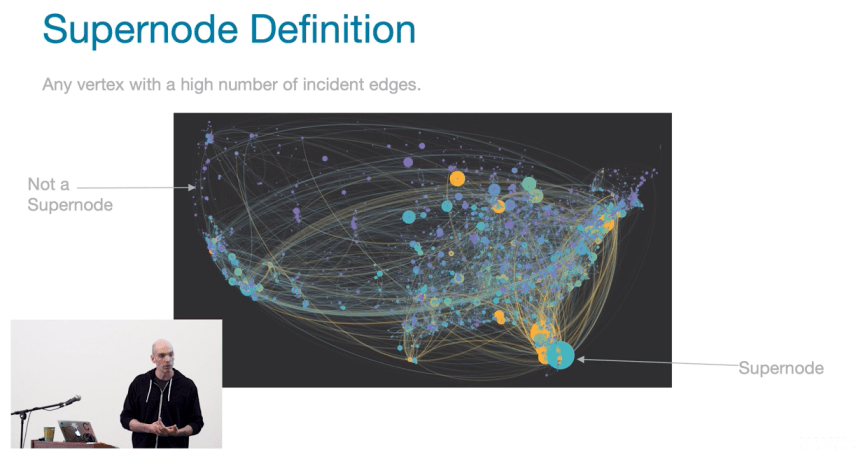
In the video, I found the definition slide for super node was perfect.

supernodes.png

See that super node? Wow, Florida is just covered up by the explosive nature of that super node! YIKES!

In the talk Jonathan also delves deeper into the vertexes, adjacent vertices, and the respective neighbors. With definitions along the way, so it’s a great talk to watch even if you’re not up to speed on graph databases and graph math and all that related knowledge.

impacts

traversal.png

The super node problem he continues on to describe have two specific problems that are detailed; query performance traversals and storage retrieval. Such as a Gremlin traversal (one’s query), moving along creating traversers, until it hits a super node, where a computational explosion occurs.

Whatever your experience, this talk has some great knowledge to expand your ideas on how to query, design, and setup data in your graph databases to work against. Along with that more than a few elements of knowledge about what not to do when designing a schema for your graph data. Give a listen, it’s worth your time.


DataStax Developer Days

Over the last week I had the privilege and adventure of coming out to Chicago and Dallas to teach about operations and security capabilities of DataStax Enterprise. More about that later in this post, first I’ll elaborate on and answer the following:

  • What is DataStax Developer Day? Why would you want to attend?
  • Where are the current DataStax Developer Day events that have been held, and were future events are going to be held?
  • Possibilities for future events near a city you live in.

What is DataStax Developer Day?

The way we’ve organized this developer day event at DataStax, is focused around the DataStax Enterprise built on Apache Cassandra product, however I have to add the very important note that this isn’t merely just a product pitch type of thing, you can and will learn about distributed databases and systems in a general sense too. We talk about a number of the core principles behind distributed systems such as the pivotally important consistent hash ring, datacenter and racks, gossip, replication, snitches, and more. We feel it’s important that there’s enough theory that comes along with the configuration and features covered to understand who, what, where, why, and how behind the configuration and features too.

The starting point of the day’s course material is based on the idea that one has not worked with or played with a Apache Cassandra or DataStax Enterprise. However we have a number of courses throughout the day that delve into more specific details and advanced topics. There are three specific tracks:

  1. Cassandra Track – this track consists of three workshops: Core Cassandra, Cassandra Data Modeling, and Cassandra Application Development. [more details]
  2. DSE Track – this track consists of three workshops: DataStax Enterprise Search, DataStax Enterprise Analytics, and DataStax Enterprise Graph. [more details]
  3. Bonus Content – This track has two workshops: DataStax Enterprise Overview and DataStax Enterprise Operations and Security.  [more details]

Why would you want to attend?

  • One huge rad awesome reason is that the developer day events are FREE. But really, nothing is ever free right? You’d want to take a day away from the office to join us, so there’s that.
  • You also might want to even stay a little later after the event as we always have a solidly enjoyable happy hour so we can all extend conversations into the evening and talk shop. After all, working with distributed databases, managing data, and all that jazz is honestly pretty enjoyable when you’ve got awesome systems like this to work with, so an extended conversation into the evening is more than worth it!
  • You’ll get a firm basis of knowledge and skillset around the use, management, and more than a few ideas about how Apache Cassandra and DataStax Enterprise can extend your system’s systemic capabilities.
  • You’ll get a chance to go beyond merely the distributed database system of Apache Cassandra itself and delve into graph, what it is and how it works, analytics, and search too. All workshops take a look at the architecture, uses, and what these capabilities will provide your systems.
  • You’ll also have one on one time with DataStax engineers, and other technical members of the team to ask questions, talk about architecture and solutions that you may be working on, or generally discuss any number of graph, analytics, search, or distributed systems related questions.

Where are the current DataStax Developer Day events that have been held, and were future events are going to be held? So far we’ve held events in New York City, Washington DC, Chicago, and Dallas. We’ve got two more events scheduled with one in London, England and one in Paris, France.

Future events? With a number of events completed and a few on the calendar, we’re interested in hearing about future possible locations for events. Where are you located and where might an event of this sort be useful for the community? I can think of a number of cities, but organizing them into order to know where to get something scheduled next is difficult, which is why the team is looking for input. So ping me via @Adron, email, or just send me a quick message from here.