What is Riak? Who builds it? Who maintains it? Can I download it? How does it work? What are the features?
Here’s the start of answers to these questions and more.
First, the basic high level description:
“Riak is an open source, highly scalable, fault-tolerant distributed database.”
That’s the first line you’ll read when checking out the product via the Basho product link. It provides good information, but here I’m going to add more to the definition without the need to dig around yourself. Maybe I can save you some time & provide some links directly to solid information in the docs. Kind of a “Cliff Notes” of Riak. Let’s take this feature by feature which will in turn get us to a definitive definition of what exactly Riak is.
Riak is Open Source.
Riak is built and contributed to by the community, with Basho being the steward and an active member that extends, builds and provides support for additional products. The avenues to reach the Riak Open Source Community members is pretty straight forward, following known avenues of communication. Hit us up on the email list, especially feel free to contribute & ask questions via the Github Basho organization, there is the Basho Riak Blog, the weekly recap and jump into the IRC chat room #riak on freenode. Oh, and there’s a twitter feed @basho.
So what exactly does this get you, when you become a user or contributor of Riak? The entire community is behind you, will help you get started using Riak and provide help whenever you run into problems. If you want SLAs or 24 hour support Basho can provide this for you. But for bugs, issues, queries, searching and all sorts of other related development questions there is the community. An open source community like this is passionate, which means you’ll have support like no closed source company will ever provide you, and absolutely no closed source product’s community will provide you. We’re talking about a different level of interest, passion and levels of personal involvement.
Riak is a key value based database store.
Riak is a key value store. What exactly is a key value store? It’s pretty simple and you’re probably already familiar with what a key value store is. A key value is made up of two pieces of data, the first is the identifier for the second element within the data structure. This gives a system or developer using key value storage a schema-less way of working with data.
Riak is designed for highly distributed environments.
This type of distributed isn’t the “we put one database over here and one database over here and you gotta figure out how they work together” type of distribution. So this isn’t some of that oddball pretend stuff Oracle keeps hoisting on people. This is the honest to goodness distribution of the sort, when one node goes down you don’t blink, you don’t stop eating dinner, you don’t sweat it. You just continue onward with life knowing full well that you’ll just spool up another node when you need to.
Riak is master-less, with no single point of failure.
This is one of self explanatory features. But what does a master-less system provide us? One thing is no single point of failure. Being that all nodes can act autonomously to work around the loss of one or more nodes it also helps add to the high availability of the system.
Riak is fault tolerant, like a disk drive you wish was real.
Ever have a backup disk drive? What? You don’t have one of those? Ugh. Ok, so imagine you had a backup disk drive that had an unfortunately high failure rate. Well, why, because you know, they have an oddly high failure rate. If you do backups like good practices dictate, eventually you’ll end up with some dead drives.
RAID, both software and hardware, are built specifically to deal with this type of failure. With a distributed system like Riak, it bumps the level of abstraction above software or hardware RAID, enabling another level of even greater fault tolerance. Not to remove the relevance of RAID capabilities, but with a multi-node system like Riak, you can easily remove nodes and swap them out as needed, keeping costs down by using simple drives in simple machines. If you want to, you could indeed get higher I/O machines and faster drives, but it isn’t necessary to insure fault tolerance in a Riak Database System.
Riak scales, with hot swappable nodes enabling zero downtime.
The ability to commit hot swappable changes while in the midst of operating starts at a very low level for Riak. The language used to build Riak, Erlang has the ability to change pieces of an application system in realtime built into the precepts of the language. This provides, at the core, the inherent capability to change out systems, and by proxy of architectural design, the ability for nodes in Riak to be changed out simply by removing them from a cluster ring. Once that is done it is just as simple to add another node or nodes back into the cluster ring, enabling a number of additional practices around upgrades, hot swaps for failures, or even version changes.
Riak can be used as a building block for distributed (aka cloud) infrastructure.
The concepts and contractual components that Riak Database is built on are available for use via the Riak Core Project. If you’re looking into starting a project around distributed systems this is a great place to get start. Also be sure to do a general web engine (re: google) search for “riak core” and you’ll find lots of material around the project, and projects people have started with the project as a base. I’m currently in the process of putting together one of these projects myself.
Riak is eventually consistent.
The term eventually consistent is becoming more and more common place. Riak is one of the many systems, that inherently often apply to distributed systems, that use the concepts of eventual consistency. The idea, is that even though all nodes may not immediately receive a new piece of data, or updated piece of data, they eventually will receive that update and by synchronized with the cluster ring of nodes. This goes back to the equality of nodes and removal of the master-less concepts, providing the availability and other capabilities, with some trade off in the synchronization of data through eventual consistency.
In Summary
That’s round one for the many features of Riak. I’ll be adding more in the future, but for now this is a good starting point in knowing about and knowing what Riak is, what it can be used for, and how it might help you extend, maintain or invent the next great piece of technology.
This week, the first thing I did was give a solid read to Mark Phillip’s Blog “themarkphillips” (@pharkmillups). Here’s a break down of some entries I found really interesting and helpful in getting kick started here at Basho (or just really a good read in and of itself):
Two Anecdotes About Community From JSConf and NodeConf – This is a great one, two anecdotes that I’m all “hell yeah” about. The entry caught my eye for the obvious reasons that the whole great team behind JSConf & NodeConf, I always have to read about. Mikael, Chris and the whole lot of Noders are a great crew of people, throwing absolutely great conferences. The two anecdotes; “You Want Your Users To Hug You” and “Meeting People In Real Life Never Gets Old And Is Incredibly Valuable”.
Another great entry revolved around putting together RICON 2012. See my other entries “RICON2012 Shreds the House!” and “RICON 2012 Photos” for more on RICON. This entry really lays out ground work for the mission Mark Phillips, Tom Santera and the rest of the team I’ve joined at Basho have to grow the community that works with, around and building distributed databases and systems.
The latest entry, the entry key to what I’m tackling, is the “Month One for Technical Evangelists at Basho“. This leads me to the next blog & entries and material I needed to dive into.
The next blog I gave a good review of was the Basho Blog.
Riak Cloud Storage with Multi-Datacenter Replication – this blog entry outlines the release of, well, what the title says. This release though, is a pretty big deal. The storage is already S3 compliant, a huge benefit in the first place. The entry goes into some detail about the full and realtime sync capabilities of the system. However if you’re really interested in this there’s more to dive into – so ping me or jump on the Basho mailing list and strike up a conversation. We love talking about this stuff at Basho, so don’t shy away from throwing some conversation our way.
The next blog entry that caught my attention, since some of my first demoes are going to be JavaScript, Node.js and Riak, the project around Riak.js getting a fresh start was a relief to read. I’ll admit, I read it when the blog entry was published. 😉
One last entry I read, then dived into the content that it links to is the “Building Apps on Riak” content and use cases blog entry. It links to the Basho Docs (see below) and use cases page.
The last two major things that I read, which are really important in the field of distributed databases and also having a work culture that seriously rocks. These two papers are the Amazon Dynamo Paper and the Valve Handbook.
The second thing I wanted to do was get Riak setup on my local machine to play with. I’d setup Riak a few times before in a multi-node cluster using Tier 3′ s Blueprint Technology to automate the process. This time however I’m taking the vantage of installing it locally for use. So what’s the steps? Well, it’s pretty straight forward. First however, I wanted to synch up my first install experience with the Basho Docs. Since the documentation is actually available via your standard open source repository on github, the Basho way, I wanted to get a local running copy of it.
Basho Documentation
I wanted to business, not just to read but also to contribute back to the basho_docs. This isn’t just some filler docs either, they’re actually really useful and well written. In other words, it’s solid, updated and well maintained documentation.
I forked the basho_docs to my own repo and went to work setting it up. Everything was going great until I stumbled into blockenspiel, or so I thought it was blockenspiel. Thus, the adventure of crazy new machine forgetfulness begins.
Breaking blockenspiel
I’ve spent a couple hours trying to get middleman working for the basho_docs project. Why did I spend a few hours working on this? Well the obvious one is I wanted to get the docs up and running locally, ya see, I intend to contribute back (want to jump into them too, hit up the github repo). While I was getting these installed I made a few mistakes and ran into a few issues. Here’s the story.
The first thing I forgot was to install rvm. The basho_docs project uses rvm and I highly suggest you use it, or something like it. In this case the project has specific settings you definitely want. The simple reason I didn’t have it is that I’d forgotten that I hadn’t installed it on my new Mac Book Air! Doh! Easily fixed via https://rvm.io/. While there I also installed the Jewelry Box App, it’s pretty decent, but you’ll still want to dive into the command line where the real power is.
So with that all good I got through the next few steps.
[sourcecode language=”bash”]$ gem install bundler
ERROR: While executing gem … (Gem::FilePermissionError)
You don’t have write permissions into the /Library/Ruby/Gems/1.8 directory.
Adrons-MacBook-Air-2:basho_docs Adron$ sudo gem install bundler
Password:
Successfully installed bundler-1.2.3
1 gem installed
Installing ri documentation for bundler-1.2.3…
Installing RDoc documentation for bundler-1.2.3…
Adrons-MacBook-Air-2:basho_docs Adron$ bundle install
Fetching gem metadata from http://rubygems.org/…….
Fetching gem metadata from http://rubygems.org/..
Enter your password to install the bundled RubyGems to your system:
Using rake (0.9.2.2)
Using i18n (0.6.1)
Using multi_json (1.3.6)
Using activesupport (3.2.8)
Using builder (3.1.3)
Using mime-types (1.19)
Using xml-simple (1.1.1)
Using aws-s3 (0.6.3)
[/sourcecode]
At this point, the install seemed to be going great, and then BOOM, this happened!
[sourcecode language=”bash”]
Installing blockenspiel (0.4.5) with native extensions
Gem::Installer::ExtensionBuildError: ERROR: Failed to build gem native extension.
/System/Library/Frameworks/Ruby.framework/Versions/1.8/usr/bin/ruby extconf.rb
mkmf.rb can’t find header files for ruby at /System/Library/Frameworks/Ruby.framework/Versions/1.8/usr/lib/ruby/ruby.h
Gem files will remain installed in /Users/Adron/.bundler/tmp/13504/gems/blockenspiel-0.4.5 for inspection.
Results logged to /Users/Adron/.bundler/tmp/13504/gems/blockenspiel-0.4.5/ext/unmixer_mri/gem_make.out
An error occurred while installing blockenspiel (0.4.5), and Bundler cannot continue.
Make sure that `gem install blockenspiel -v ‘0.4.5’` succeeds before bundling.
Adrons-MacBook-Air-2:basho_docs Adron$ gem install blockenspiel
ERROR: While executing gem … (Gem::FilePermissionError)
You don’t have write permissions into the /Library/Ruby/Gems/1.8 directory.
Adrons-MacBook-Air-2:basho_docs Adron$ sudo gem install blockenspiel -v ‘0.4.5’
Building native extensions. This could take a while…
ERROR: Error installing blockenspiel:
ERROR: Failed to build gem native extension.
/System/Library/Frameworks/Ruby.framework/Versions/1.8/usr/bin/ruby extconf.rb
mkmf.rb can’t find header files for ruby at /System/Library/Frameworks/Ruby.framework/Versions/1.8/usr/lib/ruby/ruby.h
Gem files will remain installed in /Library/Ruby/Gems/1.8/gems/blockenspiel-0.4.5 for inspection.
Results logged to /Library/Ruby/Gems/1.8/gems/blockenspiel-0.4.5/ext/unmixer_mri/gem_make.out
[/sourcecode]
Ok, so maybe I shouldn’t have used sudo, but wasn’t sure what the permissions issue was in the first place. Yeah, that’s a bad idea just to barge ahead, but sometimes you gotta just move on things. Maybe that was or wasn’t the issue. I didn’t know at this point so started to do some research.
The first thing I realized, was barely anyone had run into this issue. I did however find two things that seemed like they may be the root cause of this blockenspiel problem.
So which native extension did I need to install? I was missing it for some reason. Then I dug around a little more and discovered this in one of the logs.
[sourcecode language=”bash”]
[2012-12-07 09:50:07] ./configure –prefix=/Users/Adron/.rvm/usr
checking for a BSD-compatible install… /usr/bin/install -c
checking whether build environment is sane… yes
checking for a thread-safe mkdir -p… config/install-sh -c -d
checking for gawk… no
checking for mawk… no
checking for nawk… no
checking for awk… awk
checking whether make sets $(MAKE)… no
checking for gcc… no
checking for cc… no
checking for cl.exe… no
configure: error: in `/Users/Adron/.rvm/src/yaml-0.1.4′:
configure: error: no acceptable C compiler found in $PATH
See `config.log’ for more details
[/sourcecode]
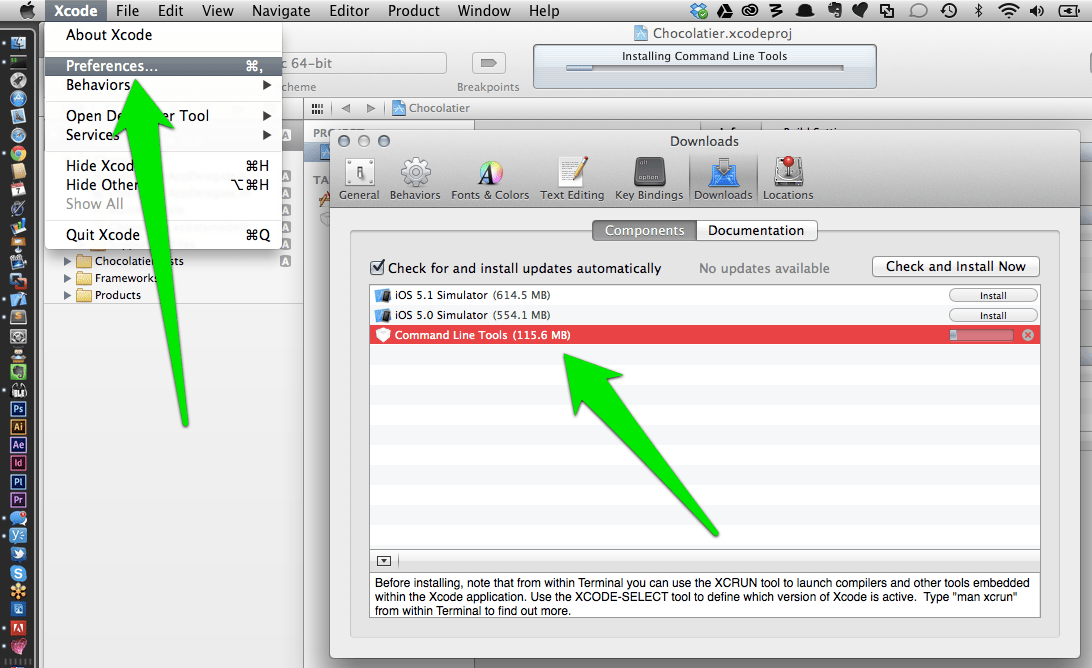
Hmmm, dammit, new machine mistake again. I needed a C compiler ASAP! Opening up XCode I immediately got this fixed by installing the CLI tools. These tools include about a zillion things I obviously needed, including the LLVM Compiler, Linker and the universally needed Make.
XCode CLI Tools Installation, for full size image click.
Ok, I finally got that installed and moved forward again. Pulled down the bits, and ran smack into the problem again. The blockenspiel lib can’t build the native extension. Ugh! However this time I got a slightly more useful error message at least.
[sourcecode language=”bash”]
/Users/Adron/.rvm/rubies/ruby-1.9.3-p327/bin/ruby extconf.rb
checking for ruby/backward/classext.h… *** extconf.rb failed ***
Could not create Makefile due to some reason, probably lack of
necessary libraries and/or headers. Check the mkmf.log file for more
details. You may need configuration options.
Provided configuration options:
–with-opt-dir
–without-opt-dir
–with-opt-include
–without-opt-include=${opt-dir}/include
–with-opt-lib
–without-opt-lib=${opt-dir}/lib
–with-make-prog
–without-make-prog
–srcdir=.
–curdir
–ruby=/Users/Adron/.rvm/rubies/ruby-1.9.3-p327/bin/ruby
/Users/Adron/.rvm/rubies/ruby-1.9.3-p327/lib/ruby/1.9.1/mkmf.rb:369:in `try_do’: The compiler failed to generate an executable file. (RuntimeError)
You have to install development tools first.
from /Users/Adron/.rvm/rubies/ruby-1.9.3-p327/lib/ruby/1.9.1/mkmf.rb:494:in `try_cpp’
from /Users/Adron/.rvm/rubies/ruby-1.9.3-p327/lib/ruby/1.9.1/mkmf.rb:919:in `block in have_header’
from /Users/Adron/.rvm/rubies/ruby-1.9.3-p327/lib/ruby/1.9.1/mkmf.rb:778:in `block in checking_for’
from /Users/Adron/.rvm/rubies/ruby-1.9.3-p327/lib/ruby/1.9.1/mkmf.rb:272:in `block (2 levels) in postpone’
from /Users/Adron/.rvm/rubies/ruby-1.9.3-p327/lib/ruby/1.9.1/mkmf.rb:242:in `open’
from /Users/Adron/.rvm/rubies/ruby-1.9.3-p327/lib/ruby/1.9.1/mkmf.rb:272:in `block in postpone’
from /Users/Adron/.rvm/rubies/ruby-1.9.3-p327/lib/ruby/1.9.1/mkmf.rb:242:in `open’
from /Users/Adron/.rvm/rubies/ruby-1.9.3-p327/lib/ruby/1.9.1/mkmf.rb:268:in `postpone’
from /Users/Adron/.rvm/rubies/ruby-1.9.3-p327/lib/ruby/1.9.1/mkmf.rb:777:in `checking_for’
from /Users/Adron/.rvm/rubies/ruby-1.9.3-p327/lib/ruby/1.9.1/mkmf.rb:918:in `have_header’
from extconf.rb:44:in `’
[/sourcecode]
My first thought was, WTF didn’t I just install the developer tools?
Went digging for this problem and found this interesting and likely related Stackoverflow Entry “”. One of the suggested solutions would be found in executing the following commands. As I read this I realized it wasn’t the marked answer, but I needed MacPorts so I downloaded MacPorts! A quick few seconds later I grabbed it and tried out these commands just to at least get things updated.
[sourcecode language=”bash”]
sudo xcodebuild -license
sudo port upgrade outdated
sudo port install apple-gcc42
sudo rvm reinstall 1.9.3
[/sourcecode]
At this point, still no go. I was getting pretty pissed. At least I was getting all these things setup on my machine, but seriously, this should NOT be this hard. The next thing I did was also update my Ruby Gems, as another place on the web suggested doing that. I tried installing middleman again.
At this point I was a bit frustrated, sat back and figured, I’ll give it a go in a while. Well after a few hours to let things sort out in my head, I picked up a completely different laptop. My Mac Book Air I’ve had and been using for over a year now. I opened up iTerm2 and through these commands in bash:
After all that, it boils down to some stupid machine load issue. So I’ll come back to fixing that machine some other time. For now, it was finally time to move on to other things. But that’s a gist of week one, and week two will be starting in just about 47 minutes. Next week I’ll be diving in a bit more to all of these things plus some actual installation, setup and related skill with Riak. Until then, cheers.
What have I been up to? Here’s a quick recap. You may want to get involved with some of these projects!
Iron Foundry & Tier 3 Web Fabric
Back when I left the kick ass team at Russell Investments in Seattle I stepped directly to bat as team lead at Tier 3. My job, get a PaaS built on Cloud Foundry and extending that with Iron Foundry. It was an ambitious effort that would provide the most extensive framework and language support available from any PaaS Provider on the market.
Well, we did it, thanks to the capabilities of Cloud Foundry Community, the great minds of Jared Wray @jaredwray, Luke Bakken, Eric Lee @saintgimp, Cale Hoopes & the rest of the Tier 3 Team! I was able to add this to my list of successes. We had some bumps, some collisions, a brick wall or two and other scheduling problems – ya know, the standard things that happen on a project. But in spite of it all, we got the Web Fabric released – and it continues to be the only PaaS available with such a wide framework and language support. It ranges from Ruby on Rails, Erlang, Node.js & Java to .NET! If you’d like to check out the open source PaaS of Cloud Foundry & Iron Foundry both projects are always looking for participation & contributions!
Thor Brings the Hamma!
After the release of the Tier 3 Web Fabric I started the search for a wicked smart and capable OS-X / Cocoa Coder – it seems their availability is pretty limited these days! Well I finally lucked out and found Benjamin van der Veen (@bvanderveen, thanks for the intro Selena @selenamarie!) to help me get started on the Thor Projects. There’s the Cocoa Thor Project & the Windows 7 WPF Metro based Thor .NET Project that we’re wrapping up with v1 releases coming really soon. To check out more on these projects that I’ve lead & coded on check out the code bases & information, all linked on ironfoundry.org. The projects are open source, so feel free to jump in and help out or fork & submit pull requests. The team will be happy to review & discuss ASAP.
While we’re wrapping these projects up right now, I’ll actually be continuing on and supporting the projects: Thor & Thor .NET. I will continue to be involved, as I was saying, in a number of ways in the PaaS space. So don’t think I’m disappearing form that realm!
Basho Sings my Song
I’ve been keeping track of Basho for a while now. Riak caught my interest many months ago as a really well built, well thought out & advanced distributed database. As you might guess, being into the whole “cloud computing” industry, I’m just ever so slightly interested in distributed systems. The other thing that I’m a huge fan of, which Basho does, is heavily support and involve itself in the open source software community and movement. The icing on the cake, was their diverse use of systems and language use around Erlang. All things that are massive wins.
Bailey’s Taproom
Well during a random conversation with Eric @coderoshi at Bailey’s Tap Room & then attending the RICON 2012 Conference (article here and pictures) I spoke to some of the team and found out they were looking for some particular skill sets. Well it just happened that I was keenly interested in meeting those skill set requirements! So December 1st I’ll be joining the Basho team full time as developer advocate, evangelist, messenger or such for the northwest working with a few people you may know such as Mark Phillips @pharkmillups, Andy Gross @argv0 (thanks for the intro James @wattersjames), Eric Redmond @coderoshi, Shanley Kane @shanley, Casey Rosenthal @caseyrosenthal and many others. Simply, I’m freaking stoked.
How This Helps You Help Me Help You
Alright, so it’s great but how can I help you in your day to day? What data do you work with? Do you work with a data scientist? Are you a data scientist? Do you work with huge sets of data, many objects, large objects? I want to know about your data usage and data problems, because there’s a good chance we’ll have more than few things to discuss. Here’s some ways I can help you, help me, help you. Ping me if you’re interested in…
talking about your data usage at the monthly Riak user group.
coding, pairing & otherwise learning Erlang and the monthly Erlang group.
interested in coding, deploying and inventing new paradigms and patterns of data storage.
interested in pairing up to learn how to deploy, migrate, upgrade or otherwise use NoSQL solutions – namely Riak.
interested in Ruby on Rails, Node.js, Map Reduce, .NET, Java, PHP and how these things can and do work against data in everything from relational databases to the new echelon of NoSQL databases.
I hope to hear from you soon and see you at an upcoming user group, cheers!
The inaugural Riak Meetup kicks off tomorrow at 7:00pm. The crew at AppFog will be hosting the meetup, with several of the Basho team coming into town with two talks:
7:15pm – Eric Redmond @coderoshi will present “Next Generation Searching with Yokozuna“. Riak Search was created to expand Riak’s query options. It’s worked well enough the past couple years, but it’s time to move forward. Yokozuna is the next generation of Riak search, built on the solid Distributed Solr platform. We’ll see a preview of what Yokozuna does, what it’s going to do, and how that’s a marked improvement from the existing Riak Search.
8:00pm – Nathan Äschbacher, developer at Coradine, will present “Riak & Node.js: The Hunt for Cheap, Easy Nines“. Portland-based Coradine makes an innovative aviation application that helps pilots the world over. Riak will power the next generation of apps and services coming out of Coradine. Nathan Äschbacher, developer at Coradine, will take you through:
A quick history of our experience with Riak
How it came to be we opted to use it at Coradine
Some of the known hurdles we were going to have to overcome (like cloud deployment)
Some of the development issues we’ve encountered
Why Node.js was a good fit for us and interfacing with Riak
Abandoning Redis in favor of Riak Memory-store for caching and 2i
So if you’re into airplanes, data, big and small, giant 9’s or other technical aspects around data storage and the respective distributed systems that enable advancements in this technology, come down to AppFog this Monday and check out these presentations.
Here I am on day #3 of my Coder’s Vacation and RICON is happening today. This is a new conference put together by the fine folks at Basho, maker of Riak (which note, is a link to the project on Github because Basho is awesome like that, they roll all open source like). However, it’s a little different and way more honest than most conferences put on by a company. Sure, there’s talk about Basho and Riak and such, but overall the conference is about distributed systems. The byline of the conference, “A Distributed Systems Conference for Developers” is not a lie. It’s hard core about systems, data and getting things built by and for people who have ideas and know about how to put these things together. To summarize RICON in one phrase, it is “BAD ASS!” Hit up the #ricon2012 twitter stream for more on this.
Conference Kick Off:
Don Rippert of Basho (CEO) took the stage and brought up one of those points, that many in the industry take for granted, but it is rarely spoke. He pointed out, and I’m paraphrasing here, that the cloud, cloud computing, nosql and all these other things really amount to one giant shift i computing. That giant shift is a move to a better way combining things together through distributed systems. Simply put focusing on nosql or cloud or whatever word that marketing and the media latches onto is just a distraction. The real focus comes down to distributed systems. Sometimes, the smartest thing to state is the obvious thing, because nobody else is pointing it out. That simple thing brings about a greater realization of what is important versus what is just noise.
That leaves me with the question though, are we as an industry starting to get it? I think that’s a good question.
Joseph Hellerstein, Professor, UC Berkeley
…with a little about him from the RICON site:
Joseph M. Hellerstein is a Chancellor’s Professor of Computer Science at the University of California, Berkeley, whose work focuses on data-centric systems and the way they drive computing. He is an ACM Fellow, an Alfred P. Sloan Research Fellow and the recipient of two ACM-SIGMOD “Test of Time” awards for his research. In 2010, Fortune Magazine included him in their list of 50 smartest people in technology, and MIT’s Technology Review magazine included his Bloom language for cloud computing on their TR10 list of the 10 technologies “most likely to change our world”. A past research lab director for Intel, Hellerstein maintains an active role in the high tech industry, currently serving on the technical advisory boards of a number of computing and Internet companies including EMC, SurveyMonkey, Platfora and Captricity.
I also really enjoyed his talk. He took a correlation between distributed systems, data and the British Empire. Correlating things, especially complex and advanced things to something like the British Empire just adds an entertaining twist to it all. Again, a description from the RICON 2012 Site:
Conventional distributed systems wisdom dictates that perfect consistency is too expensive to guarantee in general, and consistency mechanisms—if you use them at all—should be reserved for infrequent, small-scale, mission-critical tasks. Like most design maxims, these ideas are not so easy to translate into practice; all kinds of unavoidable tactical questions pop up, e.g.:
– Exactly where in my multifaceted system is loose consistency “good enough” to meet application needs?
– How do I know that my “mission-critical” software isn’t tainted by my “best effort” components?
– How do I ensure that my design maxims are maintained as software and developer teams evolve?
Until recently, answers to these questions have been more a matter of folklore than mathematics. (One way to tell the difference: a good answer is enforceable by a compiler.)
In this talk, I will describe the CALM Theorem that links Consistency And Logical Monotonicity, and discuss how it can inform distributed software development. I’ll also give a taste of Bloom, a “disorderly” distributed programming language whose compiler can automatically answer questions like the ones above. Along the way, I’ll try to shed light on side questions like “Should Paxos exist?” and “Causality: What is it good for?”
More updates, and the code for my #PhatData Project are coming up. So subscribe, stay tuned, keep reading it’ll be up soon. Cheers!




You must be logged in to post a comment.