What You Need and Want With Windows Azure Part I

The first thing needed is a Windows Azure Account, which is simply a Live ID.  The easiest way to setup one of these is to navigate to http://www.live.com and click on the Sign Up button.  If you have an existing account that you use to login it should display on this page also.


Windows Live ID Sign Up


After creating or logging in with an existing account let’s take a look at the various web properties Microsoft has dedicated to Windows Azure.

This site is the quintessential Microsoft Windows Azure Marketing Site, geared toward decision makers in management and CTO or CIOs.  There are links to many other web properties that Microsoft has setup from this page.  It’s a great starting point to find management and executive selling points such as white papers, case studies, co-marketing, and more.


Microsoft Windows Azure


The MSDN Site is the central developer resource Microsoft provides online.  The site recently underwent a massive redesign of almost every element.


MSDN Site
MSDN Site


MSDN Developers site is a requirement to bookmark.  This has the shortest navigation to all the sites and services you’ll need for Windows Azure Development.  There is even a login link to the Site #4 below.  In addition there are several key sections of this site; blogs, news, and more information.
 

MSDN Windows Azure Site


The Windows Azure Portal site is where we’ll be setting up the roles, storage, and other cloud computing mechanisms that we’ll be writing code against.  Now that each of these sites is reviewed, let’s move forward.

The Windows Azure Portal Site will prompt you to sign up for a cloud services plan.
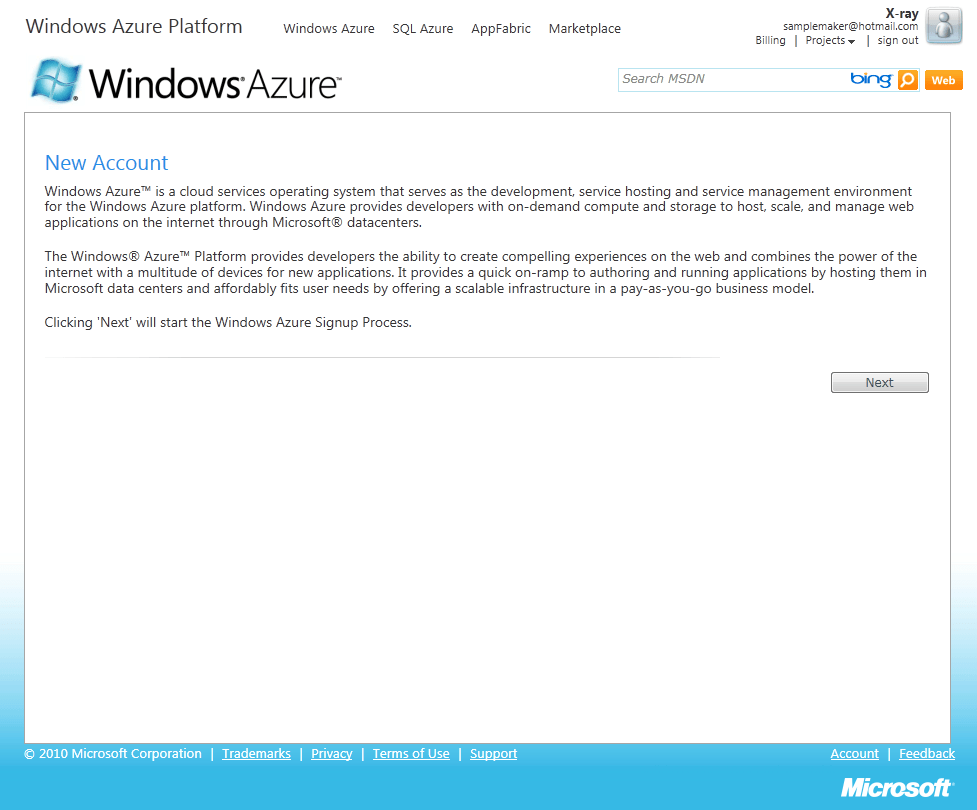
 

Signing up for a Windows Azure Service


Click on next and you will be brought to a page related to which plans you can choose from.  Depending on what specific focus you have for either development, dedicated services hosting, or otherwise you can choose from the multiple plans they have.  I won’t go into them here, as Microsoft regularly changes the plans for specials and based on market demand and current costs.


Signing up for a specific plan.


After choosing which plan you will be redirected to the billing site, https://mocp.microsoftonline.com/, to setup a line of credit, confirm the type of Windows Azure Subscription you want to start with, and other information as needed.  Once this is setup, you most likely won’t need to look at this site again except to verify billing information, change billing information, or confirm cloud usage.


Microsoft Billing
Microsoft Billing


Now that there is an account available, we’ll need to install the latest development tools for coding solutions for the cloud.  This first example will be using Visual Studio 2010 with the Windows Azure SDK.  If you don’t have Visual Studio 2010 installed yet, go ahead and install that.  Open up Visual Studio 2010 next.  We will use Visual Studio 2010 project templates to find out the latest Windows Azure SDK and download it.
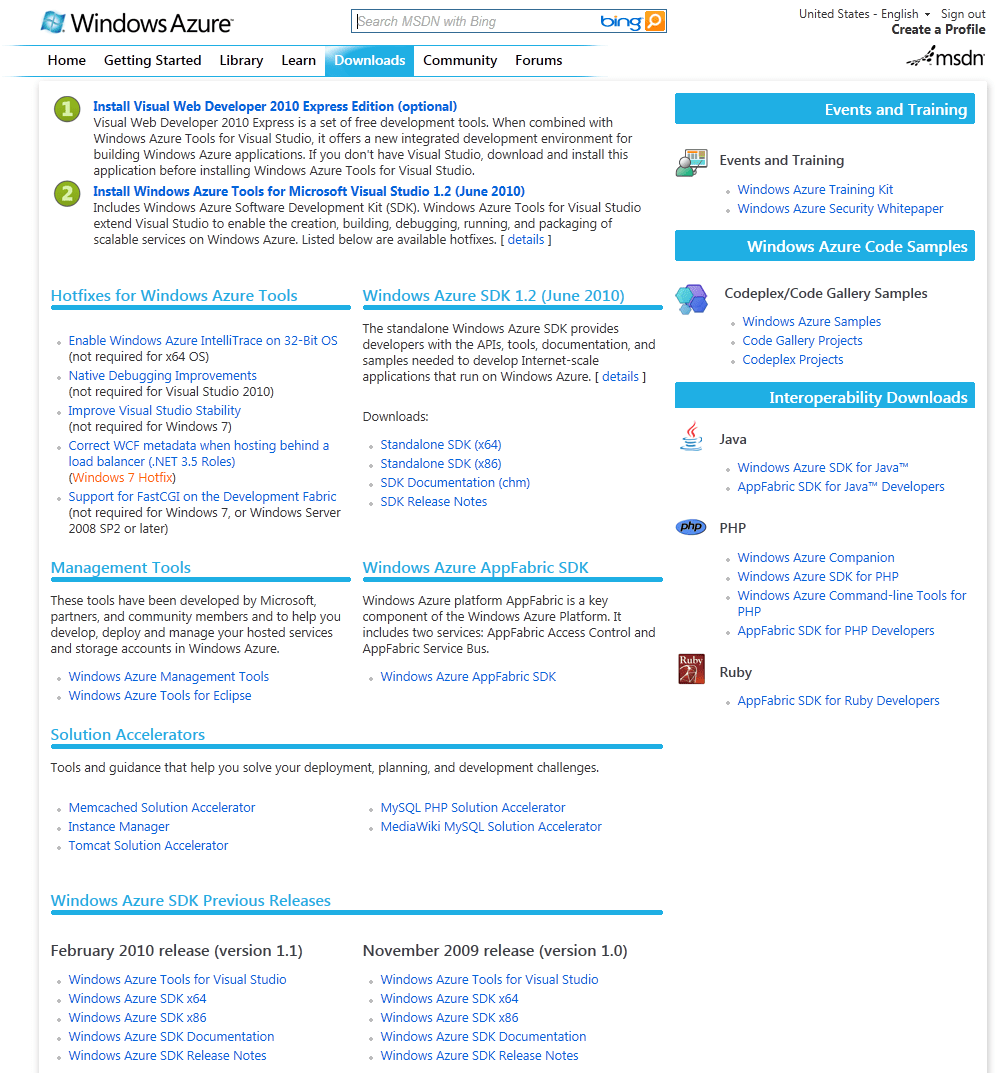
To download the latest Windows Azure SDK navigate to the MSDN Windows Azure Developers Site and click on the Downloads option at the top of the site.


MSDN Windows Azure Download Section


Once you have downloaded and installed the latest Windows Azure SDK we will download and install the Windows Azure AppFabric also.  Scroll down midway on the MSDN Windows Azure Download page and the Windows Azure AppFabric SDK should be available for download.  On the Windows Azure AppFabric SDK download page there should be a *.chm help file, two different AppFabric SDK Examples files one for VB and one for C#, and two installation packages one for 64-bit and one for 32-bit.  Download and install the one for your particular system.  I’d suggest downloading the samples also and giving each a good review.

In What You Need and Want With Windows Azure Part II I will cover how to setup the Windows Azure Microsoft Management Console.  So stay tuned, that is coming tomorrow.

Sputtering Windows Instances

I had a concern about Windows OS being used for cloud computing.  The instances in Windows Azure take a significant amount of time to boot up.  In Amazon Web Services the Windows EC2 Instances also take a long time to boot up.  Compared to Linux, Windows takes 2-4x longer to spool up in the cloud.  (Compare a boot time of about ~1 minute for Linux in EC2 vs 8-15 minutes for Windows)

Before today, this just seemed like it might be a problem I was experiencing.  I tend to believe I’m doing something wrong before I go on the warpath, but today that concern that I’d done something wrong has ended.  RightScale posted a blog entry about the difficulties of Windows in EC2.  They’re seeing the same issues I was.

Another issue that they noticed, which I too noticed, was the issues around the clocks being off.  This is a similar problem to Windows being used with VMWare and setting up images.  The clock just doesn’t ync the first time, or subsequent times.  Usually a few manual attempts need to be made.

In another entry I caught another list of issues with Windows that Linux just doesn’t have.  None of these are work stoppage issues, but they are all very annoying and would push one toward using Linux instead if at all possible.

Putting Windows Azure and Amazon Web Services EC2 side by side Network World has found them to be on a collision course.

Boiling it Down, Where Does Windows Stand?

After some serious analysis by individuals of Windows running in Cloud Environments it appears that Windows just isn’t as suited to running in virtualized environments as Linux.  A number of friends have pointed out to me how much friendlier Linux is in virtualized spaces such as VMWare’s ESX Environment.

Also based on hard analysis of VMWare versus Hyper-V, the later doesn’t appear to be as sophisticated or capable of virtualized hosting.  Is this going to cause a price point issue for Windows Azure versus AWS EC2?  Just from the perspective of requiring more hardware for Hyper-V Virtualization versus VMWare & Amazon’s AMI Virtualization it makes me ponder if this could be a major competitive advantage for Linux based clouds.  Already there is the licensing price points, so how does MS own up to that?

I would be curious to see what others have experienced.  Have you seen virtualized differences that cause issues hosting Linux vs. Windows in VMWare, Hyper-V, or AWS?  Do you foresee any other problems that could become big problems?

NETDA, Android User Group, and Week Review

NETDA
I went to the last .NET Developers Association (NETDA) in Redmond this week.  It was a decent meet, covering the Windows Phone 7.  For the most part it was some basic material, but good to get out and make some connections on the east side.
Seattle Android Users Group
On Tuesday it was time for the new Seattle Android Users Group.  This time the presentations covered two topics, and I’m going to quote from the actual meetup page:
“Two App Creation Engines Enter! One Exits!
In the red corner we have Abraham William who will be demonstrating live the Google App Inventor, and it’s untold powers in education and usability!
In the blue corner we have, coming direct from Adobe, Ryan Stewart to show Flash, and how Adobe is going to change the way you, application engineers, will write software!”
…and The Week Review in links…

AWS, WordPress, Windows Azure, Clouds, and More… (UPDATED)

A few weeks ago I published a comparison between hosting a WordPress Blog in Windows Azure vs. Amazon Web Services (AWS).  A major new feature at AWS has made the price shift even FURTHER into the Amazon’s Favor.  The release of micro-instances now makes it even cheaper, even on a pay as  you go setup.

The basic price difference is now about $100+ a month on Windows Azure and about $5-10 a month on AWS.  If you’re as wowed by getting the awesomeness that is cloud computing featuresets and technology as I am for a measly $5-10 a month go check it out yourself.

Amazon Release Micro-Instances

Biting The Bullet, Book Writing Commences

I’ve decided to go for it.  I’m going to write a book and today is the day that marks the beginning of this journey.  I’ve read up and asked for advice from writers that have undertaken the technical book effort before.  John Papa, provided some great information in the past, and even wrote a new blog entry related to some of those past efforts More Tips for Writing A Technical Book.  The previous entries are great material too;  10 Things to Consider Before Writing a Book and 6 Great Tools for Writing a Book.  I’ve read through these and am taking heed of the advice John gives.

Another blog entry I’ve come upon recently is by Bart Czernicki titled Technical Book Sales Insight Through Real-Time Amazon Rankings Analytics.

One of the things I’ll be doing, is blogging some of the notes, book sections, and other things to see if ordering, writing, and other bits work according to you the blog readers.  With that in mind, I present my first table of contents.  It’s a rough draft, but what do you think so far?

Title:  Windows Azure Cloud Computing
Subtitle: From Enterprise to Startup, A Clear Path
Chapters:
1. The History & Ideas of Cloud Computing
   a. Literal History of Cloud Computing
      i. Yesterday.
      ii. Today.
      iii. Tomorrow.
   b. Modern Cloud “Services” Focus
      i. SaaS
      ii. PaaS
      iii. IaaS
   c. Why Jump Into The Clouds
      i. First, The Disadvantages
      ii. Now, The Advantages
   d. The 60k Ft. View of Cloud Architecture
      i. Public & Private Clouds
      ii. Enterprise, Startups, and More
      iii. On Premises
2. Starting Windows Azure Development
   a. What you’ll need, what you’ll want.
   b. Other languages; Java, PHP…
   c. Build a Cloud Site & Service with…
      i. C#
      ii. Java
      iii. PHP
3. The Platform Elements of Windows Azure
   a. Web Role
   b. CGI Role
   c. Service Role
   d. Storage
      i. Blob
      ii. Table
      iii. Queue
   e. …OTHER BITS
4. Architectural Patterns for Windows Azure
   a. Queuing Patterns
   b. Storage Patterns
   c. Instance Patterns
   d. Mixed On-Premises or Private and Public Cloud Patterns
   e. Cloud to Cloud Patterns
5. Cloud Security
   a. Physical Security of Facilities
   b. Device & Data Security
   c. Cracker & Social Engineering Security
   d. Strategies for Additional Security
6. Business, Ideas and the Future of Cloud Technology
   a. Super Computing for Anyone
   b. SaaS is Ideal, but PaaS and IaaS are core.
   c. Enterprise, Startups, and the Drivers of Cloud Computing
7. Closing – Summary & Appendixes