The day before yesterday was day one, for me, of OSCON. I’d been out of town on business meet on Monday, so skipped out on the intro day. However the second day, my first, was a good time. There was already a good dose of “oh dear, I can’t attend ALL of the sessions I want to – BLASTED CONCURRENCY ISSUES!” problem. I was pondering the Intro to Erlang, then the backbone.js session, but in the end settled on Dr Nic’s @drnic session on how to deploy Cloud Foundry with BOSH.
Windows Just Doesn’t Do It
The first issue we ran into was actually the issue of prerequisites. About 30% of the audience was running Windows. To clarify the Windows question, there is no PaaS Solution that meets the following requirements:
– All Services Running on Windows
– Open Source Software
– Free or Cost
For those of you running Windows, the closest thing you can get – and I might add it’s a damn good solution – is Iron Foundry. But you’ll have to accept that there will still be some Linux involved for the Cloud Foundry parts that don’t run on Windows.
OSCON Ongoing
After the session I footed it over to the booths were a food & beer crawl of sorts was occurring, which I think might have been the first booth crawl, of two booth crawls. This was a good time, as the booth crawls usually are. It’s also fun seeing and learning about all the companies that are participating. Since everybody involved is ideally open sourced 100%, and most are at least a large percent open sourced, I always like hearing about the business models that are being used around the various products and services.
With that, this is day 1 coverage, I’ll leave you with a few photos of my first day:
The Chalk Art Wall o’ Companies & Messages (Click for full size)ESRI hanging out below the Samsung Sign… or is that perception? (Click for full size)Riot Games just before the deluge! (Click for full size)
…and with that, I’ll have a follow up post on the following days following this post. Cheers!
There are a number of new startups that have joined the third PIE Class. However there are a few that have stood out to me.
The first startup has to do with the IoT. IoT stands for Internet of Things. I’m a MASSIVE fan of what is being done with IoT. Personally I think it should be the space to watch in regard to the next big moves and big shifts in technology. From a market perspective, there’s some legitimate reasons to watch the IoT space from that view too.
Smart Mocha
With that, Smart Mocha caught my eye immediately. The description reads “Connects monitoring/measurement devices to the Internet of Things, enabling greater and more efficient access to critical data.” Their first product is Sense Simple, which is an “out of box” sensor network. This is interesting, being that existing systems that do what their Sense Simple offering does, are:
Dramatically more expensive, easily 10x or more.
Complexity in existing systems introduces vastly more points of failure, maintenance issues and other concerns.
Often not as capable for integration into other systems, Sense Simple already has “cloud control” – which is a control and device diagnostic tool to provide remote views of the sensor network.
All this, via a cellular gateway preconfigured and ready for logging data , multiple sensors, around temperature, humidity, barometric pressure, vibration, sound and more.
As I mentioned above, integration with existing industry standard sensors and the ability of the company to expand this product in the future already exceeds most of the existing offerings in the space. An example, just based on the cell gateway and cloud based control, provides a prime avenue to expand into the API space to provide even more ways to track, report and log data.
Orchestrate.io
The tag line says it all, “Add Features, Not Databases”. Orchestrate.io have designed a simple API, idiomatic client drivers as their site states. All of which enables you to get started trying tout Orchestrate.io rapidly. The goal of Orchestrate.io is to remove the need to manage a disparate array of databases and to instead focus on the data, what you want to do with the data and to develop solutions against that data. Being that it is offered as a Service akin to PaaS, IaaS and other styles of offerings, it provides the ability for you to pay for only what you use.
In today’s marketplace this is extremely ideal for a number of companies and becoming even more ideal for existing companies, legacy data and more. Got data? Check out Orchestrate.io and see if it works for you.
Summary
IoT: As I was writing above, IoT is definitely shaping up to be a huge deal in the near future. Many industries are moving back to make progress in the physical realm akin to the migrations from ‘foot travel’ to ‘horse travel’ to ‘rail travel’ to ‘air travel’. We’re going to see some huge leaps here, maybe something along the lines of ‘human vision’ to ‘augmented vision’ to ‘perceptual planes vision’. Do you even know what ‘perceptual planes vision’ is? If not, get ready for the future, things might get bumpy! Smart Mocha looks to be positioned in a good place for impact.
Big Data, Data and more data: I’m under the impression I don’t need to elaborate on the notions of big data, but I will. Data has become a major differentiator, more so than even 5-10 years ago. Data has also become an even greater pain while becoming this major advantage. From genomic research to full tracked telemetry data to high volume high scale high quality printing, our new world of big data is here to stay. Orchestrate.io can help you wrap this realm up.
Disclosure: I don’t work for either of these companies, nor am I paid by the city of Portland, but they’re on my radar as I watch Portland’s startup scene and culture. I also live and breath the culture here, I am a Portlandian. Stay tuned for more in the coming weeks as other incubators and startups keep rocking and rolling here in the city of Portland, OR.
For good coverage of Portland’s artistic side, video quality and some of our current startups and companies, give this Techtown Portland video a watch.
Attend Beer Um’ Tuesday Too (i.e. B.U.T.T.) the almost unknown yet known beer meetup from the mind of genius Jerry Sievert @jerrysievert and march over with a contingent from OS Bridge.
Plot next steps involving Bosh, Cloud Foundry, Riak and OpenShift.
Upon arriving I checked in and got the super sweet water bottle that the OS Bridge team got for speaker gifts. Gotta say good job, something a bit different, something that’s quality and something worth keeping! I dig it. I immediately washed it out and carried it around for thirst quenching the rest of the day.
Kicking Impostor Syndrome in the Head
This talk tackled the ideas of how to be more inclusive, allow people to actually gain buy in and confidence in the work they’re doing. This is a hugely important set of ideas that most of the large corporate world has no clue about. Thus the dramatically lower productivity, individual leadership, pride and happiness that people have working in large corporate enterprises & especially Government. This is a space that should be an extremely high priority for those businesses to study.
Mistakes…
Denise Paolucci did a great job engaging the crowd and relaying the ideas of how to improve work environments to really bring out the best in people. Simply, it occurred to me this could be summarized as, “Don’t be a dick, how to kick ass, and build the whole team to do just that!”
The talk included ideas such as making it safe to fail, don’t scapegoat someone around an idea that doesn’t work, but try a new path and move toward succeeding. Don’t setup people to fail, because that drags everybody down. Document things even when everybody supposedly knows those things. The list goes on, but that’s a good base for the ideas.
This session was presented by Joe Eames @josepheames. I really wanted to go check this out, as I’ve been keen on AngularJS the last couple months but have not been able to work with it as much as I’d like to. So any exposure is good exposure in my book. This is when the bad news kicked in, I had to run off and take care of some minor priorities. Errands, ugh.
For those like me, that either weren’t at OS Bridge or missed this session, this one will be put up live at some point so keep an eye out for the videos being posted. For an immediate fix, Joe has a podcast at JavaScript Jabber. He’s also got a site related to doing TDD & JavaScript at Test Driven JS.
The standard mode of arrival at OS Bridge.
DIY Electric Vehicles
My friend, beverage connoisseur and JavaScripting genius Jerry Sievert @jerrysievert strolled by and mentioned DIY Electric Vehicles, DIY Electric Cars, DIY Electric Bikes and DIY DIY DIY DIY Stuffs. So I packed and headed to this workshop without any original plan to attend anything at this time.
This was a solid session with an introduction to electric vehicles, what they look like, how they work, what types of batteries are good for this use and coverage of Benjamin Kero’s @bkero DIY Electric Bike. Really cool stuff, and something that I really want to expand on and connect even more tech, similar to this plus something like Helios Bars.
Next up…
Terraformer
Terraformer is a project kicked off by Jerry Sievert @jerrysievert that provides some pretty solid mapping toolkit. For more information on this project, check out these links:
Jerry showing off other cool Terraformer features.
Hacker Lounge
During and after all the sessions OS Bridge is fairly well known for its awesome Hacker Lounge. Before many arrived, early in the morning just before the first keynote I snapped a wide angle of the Hacker Lounge…
Hacker Lounge, unoccupied.
…and here’s a few shots of the Hacker Lounge in full effect.
A wide angle of activity ala the Hacker Lounge. Click for full size image.
…the Lego table for solutions…
Lego table!
…and hardware hacking.
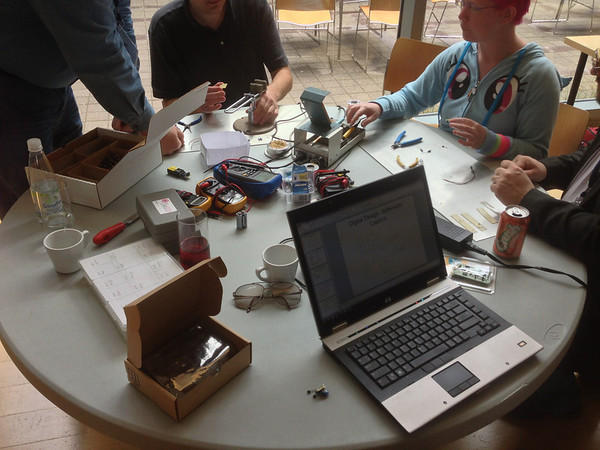
Hardware hacking, a little soldering brings together different worlds.
The Rails 2013 Conference kicked off for me, with a short bike ride through town to the conference center. The Portland conference center is one of the most connected conference centers I’ve seen; light rail, streetcar, bus, bicycle boulevards, trails & of course pedestrian access is all available. I personally have no idea if you can drive to it, but I hear there is parking & such for drivers.
Streetcars
Rails Conf however clearly places itself in the category of a conference of people that give a shit! This is evident in so many things among the community, from the inclusive nature creating one of the most diverse groups of developers to the fact they handed out 7 day transit passes upon picking up your Rails Conf Pass!
Bikes!
The keynote was by DHH (obviously right?). He laid out where the Rails stack is, some roadmap topics & drew out how much the community had grown. Overall, Rails is now in the state of maintain and grow the ideal. Considering its inclusive nature I hope to see it continue to grow and to increase options out there for people getting into software development.
Railsconf 2013
I also met a number of people while at the conference. One person I ran into again was Travis, who lives out yonder in Jacksonville, Florida and works with Hashrocket. Travis & I, besides the pure metal, have Jacksonville as common stomping ground. Last year I’d met him while the Hash Rocket Crew were in town. We discussed Portland, where to go and how to get there, plus what Hashrocket has been up to in regards to use around Mongo, other databases and how Ruby on Rails was treating them. The conclusion, all good on the dev front!
One of these days though, the Hashrocket crew is just gonna have to move to Portland. Sorry Jacksonville, we’ll visit one day. 😉
For the later half of the conferene I actually dove out and headed down for some client discussions in the country of Southern California. Nathan Aschbacher headed up Basho attendance at the conference from this point on. Which reminds me, I’ve gotta get a sitrep with Nathan…
RICON East (May 13th & 14th)
RICON East
Ok, so I didn’t actually attend RICON East (sad face), I had far too many things to handle over here in Portlandia – but I watched over 1/3rd of the talks via the 1080p live stream. The basic idea of the RICON Conferences, is a conference series focused on distributed systems. Riak is of course a distributed database, falling into that category, but RICON is by no means merely about Riak at all. At RICON the talks range from competing products to acedemic heavy hitting talks about how, where and why distributed systems are the future of computing. They may touch on things you may be familiar with such as;
PaaS (Platform as a Service)
Existing databases and how they may fit into the fabric of distributed systems (such as Postgresql)
How to scale distributed across AWS Cloud Services, Azure or other cloud providers
RICON East
As the videos are posted online I’ll be providing some blog entries around the talks. It will however be extremely difficult to choose the first to review, just as RICON back in October of 2012, every single talk was far above the modicum of the median!
Two immediate two talks that stand out was Christopher Meiklejohn’s @cmeik talk, doing a bit o’ proofs and all, in realtime off the cuff and all. It was merely a 5 minute lightnight talk, but holy shit this guy can roll through and hand off intelligence via a talk so fast in blew my mind!
The other talk was Kyle’s, AKA @aphry, who went through network partitions with databases. Basically destroying any comfort you might have with your database being effective at getting reads in a partition event. Kyle knows his stuff, that is without doubt.
There are many others, so subscribe keep reading and I’ll be posting them in the coming weeks.
Node PDX 2013 (May 16th & 17th)
Horse_js and other characters, planning some JavaScript hacking!
Holy moley we did it, again! Thanks to EVERYBODY out there in the community for helping us pull together another kick ass Node PDX event! That’s two years in a row now! My fellow cohort of Troy Howard @thoward37 and Luc Perkins @lucperkins had hustled like some crazed worker bees to get everything together and ready – as always a lot always comes together the last minute and we don’t get a wink of sleep until its all done and everybody has had a good time!
Node PDX Sticker Selection was WICKED COOL!
Node PDX, it’s pretty self descriptive. It’s a one Node.js conference that also includes topics on hardware, javascript on the client side and a host of other topics. It’s also Portland specific. We have Portland Local Roasted Coffee (thanks Ristretto for the pour over & Coava for the custom roast!), Portland Beer (thanks brew capital of the world!), Portland Food (thanks Nicolas’!), Portland DJs (thanks Monika Mhz!), Portland Bands and tons of Portland wierdness all over the place. It’s always a good time! We get the notion at Node PDX, with all the Portlandia spread all over it’s one of the reasons that 8-12 people move to and get hired in Portland after this conference every year (it might become a larger range, as there are a few people planning to make the move in the coming months!).
A wide angle view of Holocene where Node PDX magic happened!
The talks this year increased in number, but maintained a solid range of topics. We had a node.js disco talk, client side JavaScript, sensors and node.js, and even heard about people’s personal stories of how they got into programming JavaScript. Excellent talks, and as with RICON, I’ll be posting a blog entry and adding a few penny thoughts of my own to each talk.
Tea & Chris kick off Polyglot Conference 2013!A smiling crowd!
Polyglot Conference was held in Vancouver again this year, with clear intent to expand to Portland and Seattle in the coming year or two. I’m super stoked about this and will definitely be looking to help out – if you’re interested in helping let me know and I’ll get you in contact with the entire crew that’s been handling things so far!
Polyglot Conference itself is a yearly conference held as an open spaces event. The way open space conferences work is described well on Wikipedia were it is referred to as Open Spaces Technology.
The crowds amass to order the chaos of tracks.
The biggest problem with this conference, is that it’s technically only one day. I hope that we can extend it to two days for next year – and hopefully even have the Seattle and Portland branches go with an extended two day itenerary.
A counting system…
This year the break out sessions that that I attended included “Dev Tools”, “How to Be a Better Programmer”, “Go (Language) Noises”, other great sessions and I threw down a session of my own on “Distributed Systems”. Overall, great time and great sessions! I had a blast and am looking forward to next year.
By the way, I’m not sure if I’ve mentioned this at the beginning of this blog entry, but this is only THE BEGINNING OF SUMMER IN CASCADIA! I’ll have more coverage of these events and others coming up, the roadmap includes OS Bridge (where I’m also speaking) and Portland’s notorious OSCON.
Until the next conference, keep hacking on that next bad ass piece of software, cheers!
I have a workshop coming up on Friday of this week at the Vancouver BC Polyglot Conf. In addition I’ll be attending the conference itself and looking to have a lot of conversations and open spaces sessions around distributed systems, technologies, platform as a service, other *aaS and generally anything for modern, distributed, scalable architecture and systems. Hopefully I’ll get to converse with all of you about as many topics as possible – it’s always a great time to dig into these topics at conferences like these. It’s where the real next steps in technology come from!
In the coming days before and after the workshop I’ll be blogging material I have put together for the workshop. Previously I’ve put together one blog entry on backing up distributed systems ala the Riak variety. Check it out “Backup Riak – Learning About Distributed Databases :: Issue 001“.
The Workshop, for those of you interested in surviving a Zombie Apocalypse (or just learning about Riak) can sign up still, there’s a few spaces left! Below is a the basic outline of what we’ll be touching upon. There’s a LOT more topics beyond this, but we’ll save those for open space sessions. If there’s anything specific you’d like me to cover, feel free to throw a comment on the blog and I can easily add 1-2 topics of interest if attendees would like!
Introducing Riak, a database designed to survive the Zombie Plague. Riak Architecture & 5 Minute History of Riak & Zombies.
Architecture deep dive:
Consistent Hashing, managing to track changes when your kill zone is littered with Zombies.
Intelligent Replication, managing your data against each of your bunkers.
Data Re-distribution, sometimes they overtake a bunker, how your data is re-distributed.
Short Erlang Introduction, a language fit for managing post-civil society.
Getting Erlang
Installing Riak on…
Ubuntu, RHEL & the Linux Variety.
OS-X, the only user centered computers to survive the apocolypse.
From source, maintained and modernized for humanities survival.
Upgrading Riak, when a bunker is retaken from the zomibes, it’s time to update your Riak.
Setting up
Devrel – A developer’s machine w/ Riak – how to manage without zombie bunkers.
5 nodes, a basic cluster
Operating Riak
Starting, stopping, and restarting
Scaling up & out
Managing uptime & data integrity
Accessing & writing data
Polyglot client libraries
JavaScript/Node.js & Erlang for the zombie curing mad scientists.
C#/.NET & Java for the zombie creating corporations.
Others, for those trying to just survive the zombie apocolypse.
 The day before yesterday was day one, for me, of OSCON. I’d been out of town on business meet on Monday, so skipped out on the intro day. However the second day, my first, was a good time. There was already a good dose of “oh dear, I can’t attend ALL of the sessions I want to – BLASTED CONCURRENCY ISSUES!” problem. I was pondering the Intro to Erlang, then the backbone.js session, but in the end settled on Dr Nic’s @drnic session on how to deploy Cloud Foundry with BOSH.


 Upon arriving I checked in and got the super sweet water bottle that the OS Bridge team got for speaker gifts. Gotta say good job, something a bit different, something that’s quality and something worth keeping! I dig it. I immediately washed it out and carried it around for thirst quenching the rest of the day.




You must be logged in to post a comment.