A Few Things I Learned Today in Visual Studio Code

I opened up Visual Studio Code today with an intent to use it for all my editing, documenting, and coding today. My priorities today, on a day I’ve taken off from work, is to work on my upcoming Terraform Course, a little Go coding, and also a few general tasks and notes. While I work on these priorities, you dear reader, get the benefit of my random notes. 😉

Shortcut Keys

There are a few shortcut keys I’ve used so frequently it has become paramount to remember them. Otherwise it’s just wasteful trying to look them up over and over.

Mac OS

  • Word Wrap ⌥ + z that’s the option key plus the letter z.
  • Zen Mode [ ⌘ + k ] then z which involves pressing the command key and then z, then releasing those now that the command key plus z state has been initiated. With the IDE in this state, then press z and Zen Mode will begin. This is a beautiful experience once you get the shortcut keys down and really want to just look at code, content, or whatever you’re thinking through.
  • Explorer ⌘ + b that is the command key plus the letter b key. This brings up the explorer, in Zen Mode or regular mode.
  • Console ⌘ + j that is the command key plus the letter j key. This brings up the section of the IDE that has the problems, output, debug console, and terminal, with the debug console in focus.
  • Terminal ^ + ` which is the control key plus the tilde or back tick key and this brings up the previously stated panel, with the terminal in focus. Be prepared for this to take a second or two when first opening, as the engine underneath has to initiate a terminal session and is sometimes a bit clunky in starting.

Linux

  • Word Wrap Alt + z
  • Zen Mode [ Ctrl + k ] then z. As the Mac version of the shortcut command, Ctrl + k initiates the IDE state, release those keys and then press z puts the IDE into Zen Mode.
  • Explorer Ctrl + b brings up the explorer.
  • Console Ctrl + j this brings up the console with the problems, output, debug console, and terminal, with the debug console in focus.
  • Terminal Ctrl + ` which is the control key plus the tilde or back tick key. See above for specifics.

What I’d Feared for The Tech Sector

Years ago I got into technology, specifically software development and programming. I also had worked within the infosec, networking, and operations side of the industry for a while. But I’d always kind of focused on and emphasized in my career the work I did, and do within software development.

One of the things I’ve realized recently is a massive change in the industry. The technology sector, especially what is so often associated with the startup scene, has become old industry. It is on the verge of being just like other heavily regulated, unionized, slower moving, and by necessity, less innovative industries (do NOT get me wrong, all industries, even the most regulated continue to try to progress, it just becomes exponentially more difficult). The key thing to note, is the oft agile, quickly moving, intuitively inventive, progressive and out of the box thinking of software development has become dramatically more similar to something like building architecture; regulated, limited, and demanded upon by society.

These changes have been coming for a long while, since more and more of the world has been taken over by software and the computers that run the software. We’re on the verge of having so many automated things that most of humanity will know no more about the software automated nature of the things (re: automated cars, etc) then they do about internal combustion engines (they’ve been around for 160 years)

This is a time where the technology future isn’t unknown, the paths have started to be more identified and clear, and dictated to in the extreme. The Government is more involved; regulators, legislators, lawyers of every ilk, patent trolls, and more. You name it, the people who make capitalism and independent action in a market a nasty business are all at the table these days. I mean, even the nastiest of them all tried to have a tech council, but that even fell apart on dearest leader Trump.

So… ya know…

Good Riddance to Doom & Gloom

I just wrote this and realized I’d painted a pretty droll and dreary future for us developers and technologists. I’m inherently a positive person about the future, but I know the national leadership down to the rank and file citizens of this country have left me in a droll and dreary present. Thus the old pyre of depression sinks in and all of a sudden the future I can see is droll and dreary. But really, there’s hope, and so often humanity actually thrives, succeeds, and perseveres when the cards are stacked against us. But being realistic, there are some pretty staunch hands stacked against humanity these days. We’ve got our work cut out for us.

Striving to Prepare for Tomorrow

So where do we — the tech sector — as an industry go? Where do I go? I myself am not sure, I’m in the process of lining up 2018 as I write this (more on this really soon). I’m studying algorithms, looking at multitudes of industries, and trying to figure out what the future holds. What industry is actually going to take us forward into tomorrow without decimating and wrecking that very future?

The current national leadership doesn’t have a clear plan and has tried to thrash the economy into a near convulsed state to again become more reliant on coal, more oil, and other arcane forms of energy we still have a noose around our necks with. They apparently disregard the tech sector, nor seem to understand it or the rise of the clean energy sector. Eventually they’ll be gone, which hopefully our republic won’t be, and we’ll be able to again lead forward into the future. Fight to strive for industries and efforts that are the innovative, inventive, creative, builders of a better, hopeful, exciting, and clean world for ourselves.

How can I, as just one of many players in the technology sector have affect and effect in a way that prepares us for tomorrow more effectively? How can I find the traits of the industry again that I loved so much? That innovative, inventive, creative, builder structured mentality of thinking, learning, and pushing forward? The current industry seems to be as much of a roadblock to itself as the future, so I’m trying to think of ways in which I myself, and any of us can lead to better lives but still harness and enjoy those things that made us love and want to work within this industry.

…and yeah, I have a few thoughts on the matter. Which I’ve ordered by what I’m confident is the priority we need to resolve them in order to truly advance society to a more sustainable, equitable, and positive future. Not that all of these things shouldn’t be worked on right now, because they all should absolutely be!

Energy & Economic Challenges

Before we as a species can really continue thinking about the future, at least in any honest and truly long term (like say greater than 25 years even) we really need to get a handle on how we run economic systems and especially how we provide power and logistics for the planet. We’ve set ourselves up for some pretty immediate and deadly energy problems now and in the coming years. The best news is there are legitimate solutions on the table, but we’ve got to get them built!

One of the solutions, which isn’t talked about very often, is that we simply can and should use less energy. Look at much of what we’ve done in the past 50 years. Gone from 8 mpg in a car to almost 22 in a giant SUV while many cars can sustain 40 or more mpg. Even better we are moving steadily, albeit to slowly, toward electric energy for cars and road transportation. In buildings we’ve gone from houses that can barely maintain a steady temperature without extensive use of electricity (which is often in the US, created by coal). But new houses can maintain a steady temperature with a minimal amount of energy used. All of these are pretty significant advances, but there are more coming sooner in some cases then we might realize.

Tesla, Ford, and GM are all working toward advances in these realms. In railroading, well, they are and have been there for many decades. But the future may hold even more clean options for our logistical needs in this country and around the world. Hopefully it keeps moving forward as it is, and reaps the huge potential benefits that can be found there.

I keep working on and providing, when possible, options and assistance in this industry. I’m by no means a full time logistics or planner person, but my interest and fields of study often take me to work side by side with individuals in these industries. As technology moves further into freight, passengers logistics (re: cars, trains, planes, etc) I’m likely to be involved and happy to be involved in any way I can.

Housing, Technology, and Markets

The notion, and especially the nonsense, behind Government controlled markets, housing, and capitalism is under heavy attack these days. From ideological means to actual assault in the legislatures of the nation and states of this country and unfortunately, more than a few others (re: Brexit, etc). Much of the arguments form around equity, many others around the now decimated middle class since labor work is starting to be such a small part of the overall world economy. We have the proverbially defined sharing economy taking off, but it is in many ways a kind of race to the bottom for many of those working that economy as a way of life.

At the same time we have a greedy, glutenous, and excessive use of housing space and construction focused around single family homes. Meanwhile (read “Color of Law” for more on these following comments) we know with extensive historical understanding that neighborhood divisions, people segregation, and auto dependency is almost all pervasively enforced by zoning that limits most modern construction to trashy apartments and cheap, ticky tacky single family home housing. This has left many cities, where the majority of people continue to move to for entertainment, life, and work, with a severe and expensive housing shortage.

The advances in building construction, technology, and an almost complete tear down of societal neighborhood associations and Governmental zoning is required to fix these extensive housing shortages. We have to build, and regardless of economic mode (communism, socialism, fascism, capitalism, or whatever) we need more housing in cities, and the advancement of technologies along with changes to our societal organization of zoning must occur. I write must, but really it will, as it’s being forced regardless of how much opposition some push up against it. Simply we must make way for the future. What we do dictates if that future will be a good one, or one that is crumbling in our very hands as we try to build it.

I’m involved, here in Seattle (and still some when I can in Portland) to move this issue forward. The old ideas around forced segregation through zoning must die, but we also must repair our thinking and infrastructure around housing, zoning, and how and in which way we can live effectively. Cities like Seattle, Amsterdam, Copenhagen, Berlin, Vancouver BC, Portland, and others like them hold the answers and will push those forward.

Misogyny, Sexism, Racism, Bigotry…

I have lots of friends. I recently was curious and checked the overall demographics. I must do well to make friends across barriers, as the demographic range of friendships I enjoy are as diverse as the very population of the United States. I am thankful for and extremely happy that I can call so many of you friends, that we’ve all broken down, destroyed, and insured none of these societal constraints prevent our friendships.

But that doesn’t mean my network of friends, family, and loved ones throughout the world are representative of what everyone gets to experience. More barriers need destroyed, more equity needs to be found, more opportunity needs to be made available, and more lives need to be freed from petty constraints in order to help all of society move forward to a better future. The technology sector, even in it’s increasingly matured state, still has a massive and dramatic hand to play in this card game of success.

The issues, in tech and of course elsewhere, and unfortunately etched into the fibers of our entire society still need a lot of work. Let’s say, it’s easily the nastiest and most difficult refactoring of society ever. Today it needs to be intelligent, but there’s still the fights that will bring about the change, the laws that will and need to be broken, and in general, there is pain to be had. But for all of us people, this is a fight, this is pain that will endure, but intelligently we must make our world a better place.

I ask myself as everyone should; what are my biases, transgressions, and how can I insure to be a better soul today, tomorrow, and onward. How can I help others not plod forward and make ignorant, damaging, and hurtful biases and transgressions? How can I use my abilities, my privilege, and my status in various fields — not just in my tech domain — but in the city I live, the local community, the neighboring communities, and the are throughout that I influence and have some effect on?

I read and learn steadily about these topics, read from other people and persons perspectives about the world, history and how and what really happened (first step, toss that trash show they teach in public schools! To much of it is blatantly wrong and misguided!). Knowing what my fellow citizens’ actions hurt others, and also what accomplishments they did make, and how it all shaped where we are today is extremely important in bringing together people. I’ll likely write a lot more on this topic in the coming year, as my study on the topic has become more intense these days. There is indeed, a lot we all have accomplished (from jazz and blues of the delta feeding the soul and heart of America to the spikes we laid for the railroads, to the rockets we launched, the math it took, and the way we reshape our cities to make the better for all people today).


Tomorrow

Right now I’m wrapping up 2017 and these ideas were running through my mind as I wrote some code. I found it funny that I was being productive writing the code, getting the problems resolved, but all these rather complex topics were rolling around in my mind on background threads. In an upcoming post I’ll be delving into those parts of the tech industry I love so much, that I hope won’t be squelched out in the coming years. I’ll aim to structure and formalize some of the passions, projects, and efforts coming up in 2018. Until then, hope all goes well with you and yours, cheers!
Today’s post is brought to you by Bedlam Coffee in Seattle.

Today’s post is brought to you by Bedlam Coffee in Seattle. It’s an old school 2nd gen coffee shop, kitschy blue collar style, very cool and very endearing. It’s a great place to chill, read a book, hack a little, or generally talk to people in the Belltown Neighborhood. It’s a good part of Seattle and in the back of my mind I have that fear it’ll be replaced by a towering condo complex and a sterile modern steel, wood, and glass something another any minute now. But for the moment it’s a prime spot to get wired into one’s mind.

Post Topics: I’m gonna hit on a number of key topics. Curious your thoughts, and as always, tweet at me via twitter, comment here, or ping me however. Always glad to chat on things.

  • Climate Leave — The second I saw this post, by Anil Dash I immediately had a few thoughts pop into my mind. The first is all companies should start recording this climate leave data point so we can have hard data on what the climate catastrophe is costing companies in hard dollar terms. It’s a way to wake up some people’s thinking to the reality of these extremities and make climate change measurable in ways they’re currently unwilling, unable, or outright refusing to accept or address. On the other side, this is a hard reality of work and life today. For instance, the regularity in which northwest cities shut down over a little snow is frequent now. But it’s only because for many decades west coast cities have existed and not prepared for such, because such just didn’t happen with regularity. So many initial thoughts, and the post itself is really good and inspires additional thinking, as one often may assume from writing Anil tends to do.
  • The difference in JVM vs CLR worlds is quite interesting states Bart Sokol. He inquired with a 280 character tweet, which I’d love to see others weigh in on how this is perceived and played out for you.
  • An overheard Oracle conv thread from yours truly happened today too. I just can’t even start with Oracle, everytime I see their tooling in play or discussed, it’s almost always followed by a giant trash fire. The company owns so much and has so much potential to do good but instead all they do is spread horrid reputation, trash systems that could help people, and fall down on their job (i.e. go check out the Oregon health care trash fire they supposedly *built*. Not to release Oregon Gov from some responsibility, but they brought in Oracle with the idea that they knew what they were doing and they ruined the project and basically sucked the project dry of funds, leaving Oregonians without in the end).
  • The Former CEO of Brightcove took the rather broken tax plan of the current GOP (or whatever oddball ghost of the GOP it is) to task. It’s a fairly solid write up of the whole matter. It leads to lots of other things one might want to look into if you’re curious about the matter.
  • In a post that I can truly relate with, M.G. Siegler heads north on the Coast Starlight and wrote a nice piece about traveling by train. Why it’s as wonderful as it is, not particularly because of the train itself but what the train provides. To note, Siegler is formerly of Google Ventures, wrote for TechCrunch and VentureBeat among others and has a pretty well connected line with the tech industry. He’s a good person to follow and read.
  • In other news, David Mytton (who got a follow on Medium and Twitter out of this post!) and team at Server Density has finished a 9 month project to migrate from Softlayer to Google Cloud. Similar to efforts I helped kick off at Home Depot and am helping others do. If you’re interested in help around migration of systems; onsite or offsite, co-location or otherwise, to Google Cloud, AWS, or Azure reach out and let me know. I’d love to talk shop about your progress and if Pelotech or I could provide a helping hand. We’ve got a lot of experience in those efforts!

Kubernetes Networking Explained & The Other Projects

Still stumbling through determining what Kubernetes does for networking? Here’s a good piece written up by Mark Betz, titled “Understanding Kubernetes Networking: Pods”. Just reading Mark’s latest on Kubernetes is great, but definitely take a look at his other writing too, it’s a steady stream of really solid material that is insightful, helpful, and well thought out. Good job Mark.

I’ve got two more blog entries on getting Kubernetes deployed and what you get with default Terraform configuration setups in Azure and AWS (The Google Cloud Platform write up is posted here). Once complete that’s a wrap for that series. Then I’m going shift gears again and start working on a number of elements around application and services (ala microservices) development.

Always staying nimble means always jumping around to the specific details of the things that need done! This, among many efforts to jump around to the specific thing that needs done, actually feels more like a return to familiar territory. After all, the vast majority of my work in the last many years has been writing code implemented against various environments to ensure reliable data access and available services for customers; customers being web front end devs, nurses in a hospitals, GIS workers resolving mapping conflicts, veterinarians, video watching patrons on the internet, or any host of someone using the software I’ve built.

In light of that, here’s a few extra thoughts and tidbits about what’s in the works next.

  • Getting the Data Diluvium Project running, a core product implemented, and usable live out there on the wild web.
  • Getting blue-land-app (It’s a Go Service), blue-world-noding (It’s a Node.js Service), and blue-world-making (It’s the infrastructure the two run on) are all working and in usable states for prospective tutorials, sample usage, and for speaking from in presentations. They’re going to be, in the end, solid examples of how to get up and running with those particular stacks + Kubernetes. A kind of a from zero to launch examples.

Other Links of Note:

Big Ole Invisible Freight Railroads (Let’s Talk Volumes)

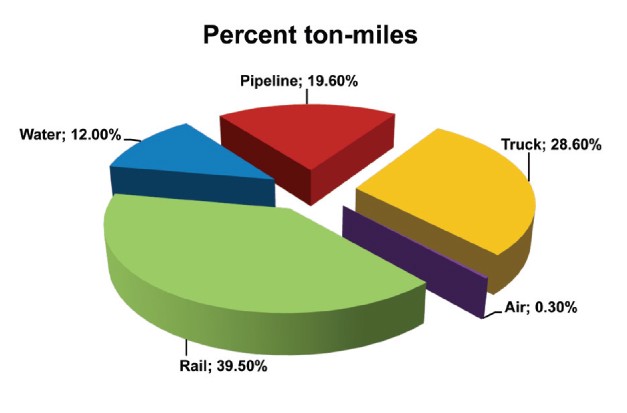
Let’s talk about freight shipments in the United States for a moment. You often see 18-wheelers and such hauling stuff back and forth on the roadways, but did you realize they only account for just shy of 30% of freight movement in the United States? At least by ton miles carried, railroads carry a whopping 40% (see this and . That’s right — the relatively invisible, barely interruptive, much cleaner than 18-wheelers or planes — freight railroads!

Ton Miles from FRA Telemetry on Freight Systems (Referenced below in FRA DOT Link)

https://www.fra.dot.gov/Page/P0362

Let’s talk about a few other things. The road systems in the US, which have the largest amount of road damage costs attributed to weather and trucking, cost the US taxpayer over $100 billion a year. That’s often $100 billion beyond the $38–42 billion a year in gas taxes we pay (more). The railroads in the United States however rarely take any taxpayer money and rely almost solely on shipping fees paid by customers. Freight railroads are one of the only entities that actually pay the vast majority of their costs in operation, capital costs, and even beyond that, unlike those dastardly automobile hand-outs, car welfare, and related subsidies! They even contribute back to society with business expansions in communities, charity programs, and more (read here, here, and here). Overall, the freight railroads have built, continue to build, and continue to be one of the greatest industrial assets this nation or any nation has ever seen. But I do digress…


That Freight Rail Data

I didn’t actually start this post to yammer on about how cool and great the freight railroads are. I wanted to talk about some data. You see, I wanted to get hold of some interesting data. I find the massive freight movements of the railroads, and overall in the United States, rather interesting. Thus I set out on a quest to seek out and find all the data I could. This is the path and data I found, and soon you too will find this data showing up in the applications and tooling that I build and distribute — via open source projects and other means — to you dear reader!

Just for context here’s some of the details of the data I’m going to dig into. The following data is primarily monitored and managed for markets and regulatory reasons by the Government entity called the Surface Transportation Board, or STB. The STB’s website is straight up circa 1999, so it’s worth a look just for all that historical glory! Anyway, here’s the short description from the STB’s site itself.

The Surface Transportation Board is an independent adjudicatory and economic-regulatory agency charged by Congress with resolving railroad rate and service disputes and reviewing proposed railroad mergers.

The agency has jurisdiction over railroad rate and service issues and rail restructuring transactions (mergers, line sales, line construction, and line abandonments); certain trucking company, moving van, and non-contiguous ocean shipping company rate matters; certain intercity passenger bus company structure, financial, and operational matters; and rates and services of certain pipelines not regulated by the Federal Energy Regulatory Commission. The agency has authority to investigate rail service matters of regional and national significance.

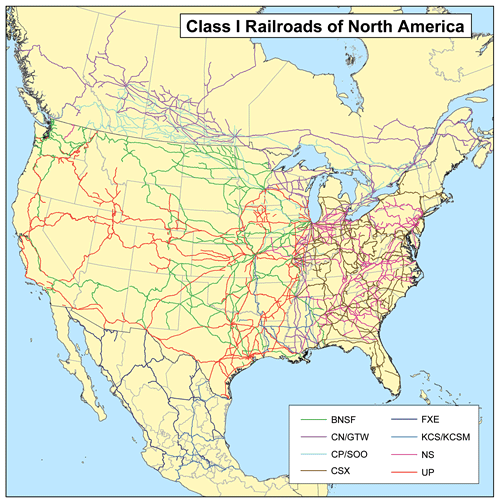
The STB is one place that has a lot of regulations in which garners up a lot of data from the class I railroads. Overall these class I railroads make up the vast bulk of railroads in the United States, and also Canada and Mexico! Overall, there are over 140,000 miles of track that the railroads operate on. All built and managed by the freight railroads themselves, except for a few hundred miles in the north eastern area of the United States. For comparison that’s 140k miles of railroad and our Eisenhower Interstate Highway System is only 47,856 miles, and costs about $40–66 billion per year (amazing Quora answer w/ tons of ref links) just in maintenance and upgrades!

The defining classification of railroads in the United States by the simple designation class 1 railroad as listed on Wikipedia.

In the United States, the Surface Transportation Board defines a Class I railroad as “having annual carrier operating revenues of $250 million or more in 1991 dollars”, which adjusted for inflation was $452,653,248 in 2012.[1] According to the Association of American Railroads, Class I railroads had a minimum carrier operating revenue of $346.8 million (USD) in 2006,[2] $359 million in 2007,[3] $401.4 million in 2008,[4] $378.8 million in 2009,[5] $398.7 million in 2010[6](p1) and $433.2 million in 2011.[7]

Association of American Railroads (AAR)

The AAR provides a number of rolled up data points, tons carried totals, and many other interesting pieces of data in their data center pages. This isn’t always useful if you want data to work with, but it was one of the first sources I regularly stumbled upon in my search for actual load data and such.

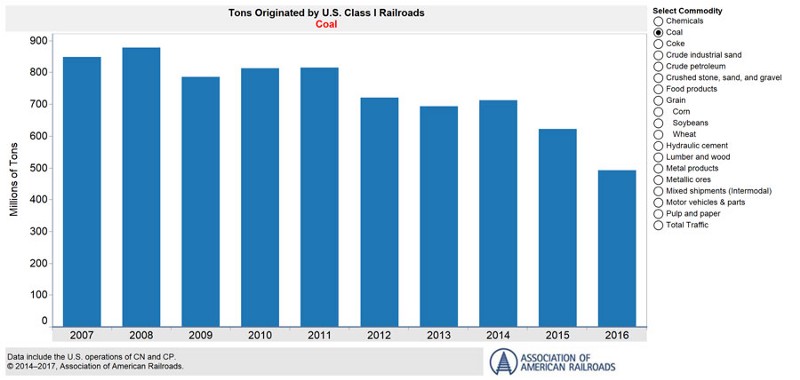
The AAR also posts weekly load data totals which shows some pretty awesome graphs of ton loads and related. There are a lot of things that can be discerned from this data too. Such as, unlike Trump’s stupid declaration about something something coal this and coal that, it’s dying off as a commodity for energy.

Almost down ~40% or so from 2007.

Anyway, amidst the STB and AAR I kept digging and digging for APIs, source data, or something I could get at that had a better granularity. After almost an hour of searching this evening I realized I was getting into this mess a bit deeper than need be, but hot damn this data was fascinating. I am, after all a data nerd, so I kept digging.

I finally stumbled on something with granularity, at least daily, with YCharts. but the issue there was I had to sign up for a subscription before I could check anything out. So that was a non-starter. Especially since I didn’t even know if the granularity would go down to what I’d like to see.

Realizing that looking at regulatory bodies and related entities wasn’t going to get down into the granularity I wanted, I got curious about the individual railroads. There are only 7 class I railroads so why not dig into each specifically. Off I started on that path!

The first thing I stumbled on with this change in effort is this hilarious line, “Union Pacific’s Lynden Tennison doesn’t exactly have a problem with “Big Data.” But unlike most CIOs, he wants one.” in this post about the big data. I immediately thought to myself, “Oh LOLz do the railroads really even know the data they’re collecting, surely they do, but maybe they’re not even sure where it’s actually at!” Of course, this is entirely possible that they’re all just sitting on this treasure trove of data and it’s being squandered off in some regulatory office of bean counters versus actually being available to innovate on. For the railroads or others for that matter. Albeit I’ll give Tennison at least he’s probably on the right path, Union Pacific hasn’t been doing a bad job lately.

I then found the weekly and related reports on Union Pacific’s site under their data area. But again, this was duplicated PDF files that I saw in the AAR reports. Not very useful to work with.

As I realized this was an effort in vain, I also stumbled upon the reality that the railroads buy big hardware and software, vastly overpriced, to do very specific things with. The costs tend to be validated in operational improvements, but much of it is overpriced IBM or Oracle deals where they’re getting raked over the coals. In other words, IBM and Oracle are landing some sweet sales but the railroads aren’t. It kind of makes them all that much more impressive that they cost Americans so little actual money and provide such a massive service in return.

With that, my efforts end without success for today. But I’ve gained a few more tidbits of trivial knowledge about the STB and AAR that I oddly enough, as a fan of rail systems, didn’t have. Thus, it was kind of successful.

Oh well, back to searching for other interesting data to work with!