Your Wake Up Lagniappe Dose!

Welcome to another metal Monday morning wake up call. Here’s your dose, get going, may your thrashing code be the best ever!

Unearth is back with some Incinerate!

If you dig Adele, here’s a version of the song Hello that’ll go over better for the metal inclined.

Then for a little melodic death metal, check out the this Deadtide.

For a little extra, check out this Behemoth cover by Ada Kaczanowska.

TRIP REPORT: O’Reilly Velocity & Software Architecture Conf 2019

This past week the O’Reilly Velocity and Software Architecture Conferences took place. I’ve attended both before, the 2nd time for Velocity in San Jose and the 2nd time for Software Architecture, however this time in San Jose and the last I attended was in London. The locations for these conferences dictate much about what is presented and how conversations, meeting and interacting, learning, and explorations take place during the conference, but more on those specifics in a moment.

The overarching theme from keynotes and many of the conversations I had met on a few key topics:

  1. When you’re building software, and you want to do it well you first and foremost must, absolutely must, invest in the people building your software.
  2. Focus on simplicity, remove complexity at every opportunity.
  3. Organizational structure can have direct impact in the complexity or simplicity of software, structure your organization efficiently and make every effort to keep it simple.

TLDR; Keep your people happy, focus on simplicity, minimize organizational noise from bureaucracy.

Topically Elaborating on Edge and Serverless

Ok, so a number of conversations came up around edge computing and serverless. Both interesting, but it also seems like there isn’t a strong play for the Enterprise is either space just yet. At this point however, a lot of enterprises are struggling with their Kubernetes, Cloud, and Hybrid solutions enough as it is that they haven’t even broached the edge compute and serverless realm. But that hasn’t stopped a lot of forward thinking individuals to start tackling how to cut out a useful spectrum of application with both edge and serverless.

Serverless Oh My!

Serverless, like so many other names, is kind of a garbage name at first. It effectively tells us nothing useful. It’s a word that requires more words just to give it meaning. It’s kind of like if I said “I like food!” What does this even mean? So, everybody eats food and most people like it, so what does “I like food!” actually mean? Same with serverless, because the first thing it doesn’t mean is a system that has no servers. What it generally means is something about your applications and you not doing anything with servers. It’s the mythic NoOps by simply removing the computers somehow.

Serverless, or simply code that executes via compute, and you get a result, has actually been around for some time. There were a number of startups that were well ahead of AWS Lambda and the other respective implementations that Azure and GCP have. These startups had been attempting to usher in what it took AWS’s massiveness and clout to actually get people to pay attention to. Serverless however has gone far beyond merely Lambda at AWS and now we’ve got to contend not only with the option in the existing cloud providers but where, how, and when can we get it into our data centers! The TLDR is that enterprise wants serverless and they’re interested in throwing it onto Kubernetes or whatever they’ve got. But often the infrastructure and systems to really make use of this simply isn’t there.

Most of the conversations I had evolved around the who, what, where, when, and how do we make use of these options for what we do? This is where most companies, at least enterprise and large companies, currently seem to be in the market. Then there are the companies that have already made the leap and are doing all sorts of stuff with Lambda and related serverless offerings. The gulf, that middle ground, doesn’t seem to have been broached by many others. Everybody, anecdotally of course, seems to be either trying to figure out how to start or already made the leap!

Edge Compute

This kept coming up, regardless of how or what people defined it as, it came up as something a number of people were very interested in. This notion, loosely based around using edge devices; smart phones, IoT devices, your car, or your washer for example, it could be almost anything. These devices do compute on the edge and thus the term. However it’s interesting because it isn’t like, for example, cloud computing that has core features like compute, storage, and related elements. Edge computing can run the gamut of any device doing any kind of work and the related capabilities of that device. It kind of leaves the space wide open. However, there were a few focal points that kept coming up.

The most common topic that came up around edge computing was doing tasks at point of presence. Such as having a phone do facial recognition, computing path finding (i.e. traffic directions), and related compute on the device versus round tripping it back to the cloud. It almost seems like after all these years of pushing things to the server we’re really starting in earnest to bring smart processes and tasks back to the devices we have in hand – no pun intended. It’s an interesting space, interesting paradigms, and I’m still not ready to call a specific thing within the world of edge compute and say, “that’s the next billion dollar idea”. Largely because, there are a lot of billion dollar ideas out there these days.

Speaking of edge compute and serverless, my fellow DataStaxian also had a few of these conversations on said topics. Patrick wrote up a post on a few observations over on the DataStax blog “Velocity Conference Shows What’s Gaining Velocity in Data Management“.

Geographic Location

As I mentioned, this set of conferences is in San Jose, the home of Silicon Valley, but the southern segment of the area. It’s a walk-able area with a number of places to break out from the conference and really dig into the hallway tracks (i.e. impromptu conversations!) that come up. For those willing to jump on the light rail, or scooter around, San Jose opens up even more to the local area providing a wide variety of coffee, food, and other operations to share conversations over.

All in all, the geographic location for the event is solid, being in the center of the city where it is. However one issue did arise, the Marriott lost power as an electrical fire in the control room of the multi-story hotel blew out the power. At last I checked upon leaving, it still didn’t have power! With the temperature at 105f going on multiple days at this point, the hotel because extremely hot inside, and being a kind of sealed airspace the air calculators also weren’t refreshing the air. That left a number of guests in less than stellar condition to attend, let alone attain value, from the conference events. Myself I ended up checking out in short order, getting sick the last day of the conference anyway, and being unable to provide the presentation that I had paired up with Lena (@lenadroid) for! I’ve been thinking, that maybe she and I can provide an online version of it for those that had wanted to hear us present on “Flexible Cloud Architectures: Decision Making Best Practices“.

Next year’s Velocity looks like it’ll be in Santa Clara, which doesn’t really excite me as it’s kind of a nebula of sprawling suburbia of boredom. This is were location becomes fundamental to what will or what can be the potential of secondary and tertiary conversations at a conference like this. Don’t get me wrong, the hallway track is excellent, but having options to step out and walk across the street from the event to converse further adds a tremendous value.

Santa Clara simply doesn’t do that unfortunately.

The fortunate thing between now and then, albeit the conference is moving to Santa Clara, they’re having subsequent conferences in the Velocity series in Berlin, and Software Architecture Conf series in the amazing cities of New York and Berlin. Those locations are worth traveling to for far more than a conference, increasing my interest in attending both of those future events. I’m looking forward to these!

Twitter Talk @VelocityConf

From @DataStaxDevs a thread! Click through for all ~17 parts.

Some Build Engineer Work – Click through for the whole construction thread.

Some of the Keynote Threads

Alena Hall – @lenadroid

Jessica Kerr – @jessitron

…and there were a bunch of others too, solid, check out the hash tag of #velocityconf to read up on more.

The Lagniappe

After the conference I finally managed to pick up a pocket Constitution.

If you’re ever in search of good coffee in San Jose, one place I found that’s tops is Academic Coffee, both the coffee and service are great. Good jovial crew and lots of cyclists in and out.

Making progress on the CaSMa, tweeted a bit on the topic while en route to the conference. If you’d like to get involved, please do let me know!

Other arbitrary statistics:

  • Stickers collected: 11 unique, ~7 of each. Total: 77 stickers.
  • T-shirt Swag: 2.
  • Conversations @ DataStax Booth: 11
  • Hallway Track Conversations: 7
  • Coffee Consumed: 9 over 3 days.
  • Twitter Filters Discussed: 123.
  • Fuel burned to compensate for electrical fire damage for the time of the conference: Approximately 5k gallons of fuel for the Marriott Hotel and no idea how much more fuel was or is still being burned to power the hotel.
  • Times the power still went off even with the diesel engine power trailer attached: 4.

Cassie Schema Migrator >> CaSMa

A few weeks back I started working on a schema migration tool for Apache Cassandra and DataStax Enterprise. Just for context, here are the short definitions of what each of the elements of CaSMa are.

  • cstar-iconApache Cassandra
    • Definition: Apache Cassandra is a free and open-source, distributed, wide column store, NoSQL database management system designed to handle large amounts of data across many commodity servers, providing high availability with no single point of failure.
    • History: Avinash Lakshman, one of the authors of Amazon’s Dynamo, and Prashant Malik initially developed Cassandra at Facebook to power the Facebook inbox search feature. Facebook released Cassandra as an open-source project on Google code in July 2008. In March 2009 it became an Apache Incubator project. On February 17, 2010 it graduated to a top-level project. Facebook developers named their database after the Trojan mythological prophet Cassandra, with classical allusions to a curse on an oracle.
  • dse-logoDataStax Enterprise
    • Definition: DataStax Enterprise, or routinely just referred to as DSE, is an extended version of Apache Cassandra with multi-model capabilities around graph, search, analytics, and other features like security capabilities and a core data engine 2x speed improvement.
    • History: DataStax was formed in 2009 by Jonathan Ellis and Matt Pfeil and originally named Riptano. In 2011 Riptano changes names to DataStax. For more history check out the Wikipedia page or company page for a timeline of events.
  • command-toolsSchema Migration
    • Definition:In software engineering, schema migration (also database migration, database change management) refers to the management of incremental, reversible changes to relational database schemas. A schema migration is performed on a database whenever it is necessary to update or revert that database’s schema to some newer or older version. Migrations are generally performed programmatically by using a schema migration tool. When invoked with a specified desired schema version, the tool automates the successive application or reversal of an appropriate sequence of schema changes until it is brought to the desired state.
    • Addition reference and related materials:

iconmonstr-twitch-5Over the next dozen weeks or so as I work on this application via the DataStax Devs Twitch stream (next coding session events list) I’ll also be posting some blog posts in parallel about schema migration and my intent to expand on the notion of schema migration specifically for multi-model databases and larger scale NoSQL systems; namely Apache Cassandra and DataStax Enterprise. Here’s a shortlist for the next three episodes;

The other important pieces include the current code base on Github, the continuous integration build, and the tasks and issues.

Alright, now that all the collateral and context is listed, let’s get into at a high level what this is all about.

CaSMa’s Mission

Schema migration is a powerful tool to get a project on track and consistently deployed and development working against the core database(s). However, it’s largely entrenched in the relational database realm. This means it’s almost entirely focused on a schema with the notions of primary and foreign keys, the complexities around many to many relationships, indexes, and other errata that needs to be built consistently for a relational database. Many of those things need to be built for a distributed columnar store, key value, graph, time series, or a million other possibilities too. However, in our current data schema world, that tooling isn’t always readily available.

The mission of CaSMa is to first resolve this gap around schema migration, first and foremost for Apache Cassandra and prospectively in turn for DataStax Enterprise and then onward for other database systems. Then the mission will continue around multi-model systems that should, can, and ought to take advantage of schema migration for graph, and related schema modeling. At some point the mission will expand to include other schema, data, and state management focused around software development and data needs within that state

As progress continues I’ll publish additional posts here on the different data model concepts and nature behind various multi-model database options. These modeling options will put us in a position to work consistently, context based, and seamlessly with ongoing development efforts. In addition to all this, there will be the weekly Twitch sessions where I’ll get into coding and reviewing what coding I’ve done off camera too. Check those out on the DataStax Devs Channel.

If you’d like to get into the project and help out just ping me via Twitter @Adron or message me here.

TRIP REPORT: 5 Items for Your Presentation Checklist and My Trip Log for DevOps Days YVR

A Few Trip Details

logoRecently I spoke (video below, plus others) at DevOps Days YVR. YVR is the airport code for Vancouver BC, thus the use of YVR in the DevOps Day name and Twitter handle (@DevOpsDaysYvr). I always love to travel to Vancouver BC for a whole multitude of reasons. The city is beautiful, clean, and has everything from shopping to foodie options all over the place. It’s a truly modern, and by US standards, futuristic city with a number of very effective transport options beyond the myopic use of cars that America is overly dependent on. If you like biking, this is the preeminent city to bike in of all cities in North America. Nothing even comes close. Not Portland, definitely not San Francisco, and don’t even get me started on the trash fire that is Los Angeles and it’s heroin like addiction to sitting in car traffic. If hanging out in the city is a bit much, one can always get out to mountains or just take a stroll into one of the many parks available to get away from it. Overall, Vancouver is an amazing place and any excuse I have for crossing the border and getting a great dose of Canadian Camaraderie and jolliness I’ll take in a heartbeat!

Of course, all the wonderfulness is great, but getting into the nitty gritty of the tech scene is also fun. Vancouver has a great tech scene, albeit small by Seattle’s tech scene, but that’s a disingenuous comparison anyway. It’d be like comparing Seattle aeronautics scene with any other city except where maybe Airbus is located, it’d just be nuts. But compared to most other cities, Vancouver has a pretty solid standing among the coding community.

Photo Mar 29, 11 29 19 PM

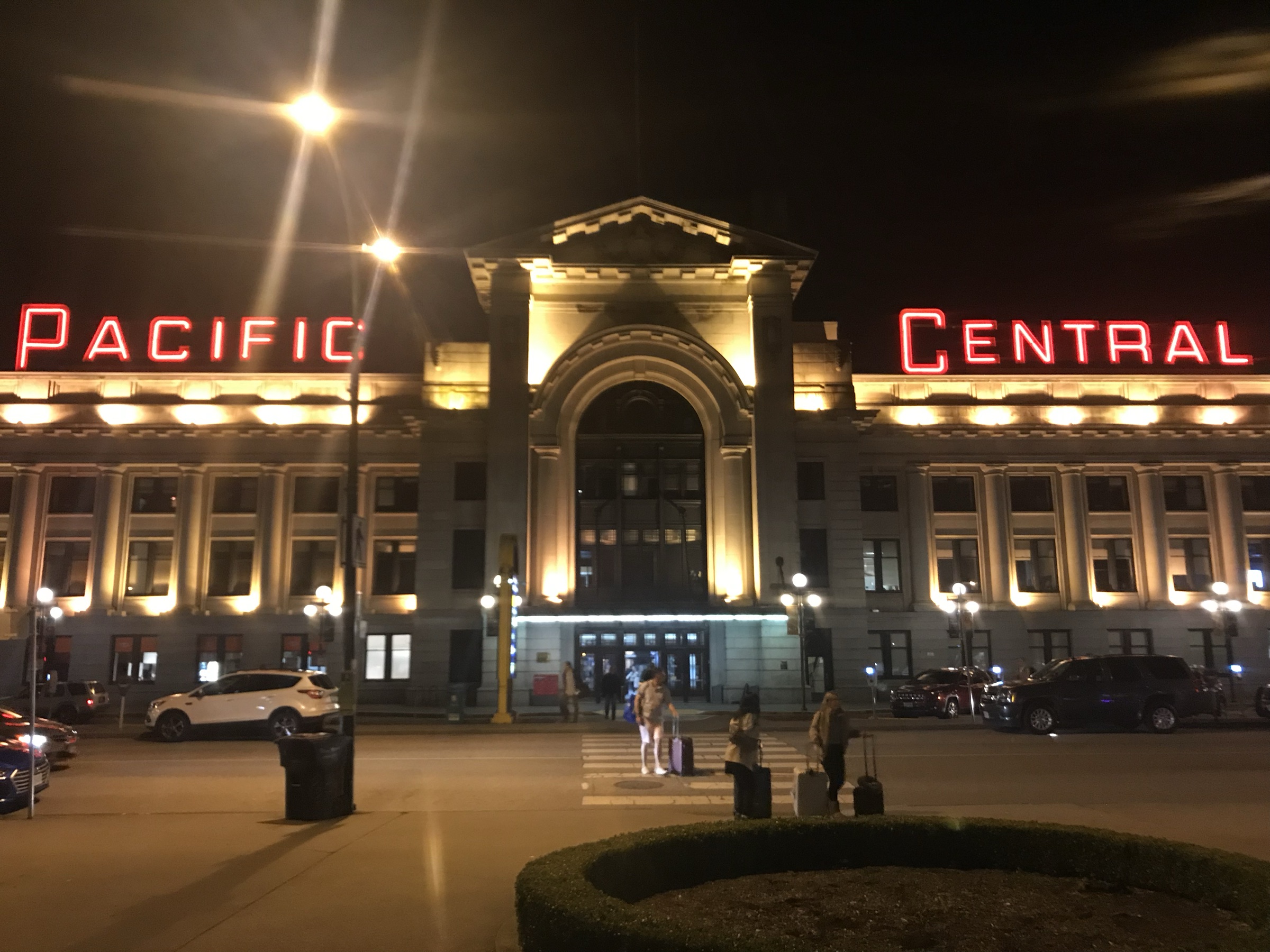
Pacific Central Station in Vancouver

I took the train up, as I always do, because of a number of reasons. I can roll my bike on and then upon arrival the staff just hands it back to me and off I go. Considering my origination point and departure point are both bike friendly for my needs, this is my default. In the end, it actually ends up faster than driving and needing to pack or rack the bike, I couldn’t even fly and enjoy these amenities, and the intercity Bolt Buses are just yucky anyway. It’s like flying except you’re stuck on the ground in an often times smaller seat than an airplane. I’m not sure why I’d ever want to torture myself like that. The other huge benefit is it’s extremely easy to get a lot done on the train and one also can’t beat the views en route!

A Small Rant

Once I arrived I checked into my hotel. I realized this trip I must have checked into the singularly clueless hotel in the whole city that has strange myopic, draconian, and stupifying bicycle options. The Hyatt Regency, which I’m clearly not going to be staying at again, wanted to “valet” my bike with a tag, mark it and put it into some basement garage “room”. I wouldn’t easily have access to it and would have to wait for them to retrieve it if I needed it for any reason. Anyway, this was an extremely odd scenario, and would be a lot more work on their part, that just struck me as blatantly behind the times – especially for Vancouver. People and businesses in this city should, and do, know better than to have such nonsense in place. I guess the Hyatt Regency places itself above and removed from the people in some way. Oh well, lesson learned, I’ll stay at one of the other zillion super awesome hotels (or with friends instead).

TLDR; Avoid the Hyatt Regency for future stays, they have strange policies around independence of movement and storage of personal items.

DevOps Days YVR

Alright, on to the conference. The conference was great, my only issue was my own fault, in that I had managed to not be able to attend the first day. I should have gotten there earlier and also planned to stay a little longer. Next time I’m going to make a more official scheduled brunch, dinner, drinks, and maybe a meetup or two. On day two of the event, I was up to speak first thing in the day, a 9:15 am slot! This was the first time I’d ever had a speaking slot this early in the day. At this point, my preparations complete, my checklist checked twice, and I was ready to present. In doing so, I decided a list was in order which I’ve put together below.

The Presentation Checklist

  1. Laptop(s) – These days I tend to bring two laptops when I’m presenting. One is my main workstation running Linux and the other is an older Macbook Pro that I have. The reasoning is simple, depending on the projector and connection options, the Macbook Pro is easily – with its HDMI connection – the most standard setup for presenting. It works more often than any other machine I’ve ever had and is far more consistent in getting resolutions correct for presentations and for projectors. It is in essence the ultimate backup. However I use the Linux machine if I can, it’s more than capable, but some projectors aren’t up to it.
  2. Connectors – I bring the regular assortment of connections to ensure I get feed out from the XPS 15 running Linux or the MacOS to HDMI and VGA. This basically covers every modern projector and everything I’ve ever seen built for the last decade or so. That equates to 2 dongles, one of the Mac (Thunderbolt to VGA) and one for the XPS 15 (USB-C/USB to VGA).
  3. Slide Deck – I aim to have several formats of the presentation deck available outside of some online format like Google Slides. Such as PDF that I can flip through or a local presentation app that I can use. This way regardless of the connection I’ll be able to have the slide deck ready to go.
  4. Presentation Page – This is a page that I setup for slides, video, and whatever other collateral is put together from my efforts and also from the conference organizers’ perspective. For the particular DevOps Days YVR talk I setup a page “Go for Venomous Database Reliability“.

5. Be Present – Be sure to be rested up the day of presenting and for a day of interactions. But don’t just come in like a military insertion assault and then leave. That sucks for attendees, stay for the day. Talk to people. Learn about what they’re working on. Chat about solutions both directions. Be part of the community.

With the checklist done, here’s my talk from the event. “Architecture Guidance for Venomous Database Reliability Engineering” a kind of library checklist for development and database reliability in Go.

After the conference I spent the day catching up with some friends. Included in that was the chance to hang out with Alexandra with Advanced Tech Podcast. We got some food near the office and plotted out a podcast too. Which you can give a listen to at “Adron Hall – Coder, Engineer, Architect“. We tackled a very wide range of topics, tech related, and even toward the end we got into discussions around livability, urban planning, city council meetings, and the whole life of an advocate in the urban realm in America.

It was a great weekend of talking tech, enjoying the beauty and good grub and company in Vancouver BC. Over the next week or three I intend to post videos from the conference with some succinct write ups on the various talks – available via the DevOpsDays Vancouver 2019 Playlist. For now though, time for a little disconnect and the train ride home, enjoy the scenery, cheers! \m/

Learning Go Episode 4 – Composite Types, Slices, Arrays, Etc.

Episode Post & Video Links:  1, 2, 3, 4 (this post), 5, 6, 7, and 8. Non-linked are in the works! Videos available now on Youtube however, so check em’ out!

If you’d like to go through this material too in book form, I highly suggest “The Go Programming Language” by Alan A.A. Donovan & Brian W. Kernighan. I use it throughout these sessions to provide a guideline. I however add a bunch of other material about IDE’s, development tips n’ tricks and other material.

8:00 Starting the core content with some notes. Composite types, arrays, slices, etc. 11:40 Announcement of my first reload – http://compositecode.blog/2019/02/11/… – second successful time blogged here) of the XPS 15 I have, which – https://youtu.be/f0z1chi4v1Q – actually ended in catastrophe the first time! 14:08 Starting the project for this session. 16:48 Setting up arrays, the things that could be confusing, and setup of our first code for the day. I work through assignment, creation, new vs. comparison, and various other characteristics of working with arrays during this time.

fmt.Println("Hello, let's talk composite types.")

basketOfStuff := [3]string{"The first string","second","This string."}
var zeeValues [2]int

for i, v := range basketOfStuff {
	fmt.Printf("Value %d: %s\n", i, v)
}

fmt.Println(zeeValues)

if zeeValues[0] == zeeValues[1] {
	fmt.Println("The values are the same, this doesn't instantiate like the `new` keyword.")
} else {
	fmt.Println("The way go appears to instantiate unset variable values, such as in this array is like the `new` keyword instantiation.")
}

zeeValues[0] = 1 + 52 * 3
zeeValues[1] = 9

fmt.Println(zeeValues[len(zeeValues) – 1])

View the gist on GitHub

29:36 Creation of a type, called Currency, of type int, setting up constants, and using this kind of like an enumerator to work with code that reads cleaner. Plus of course, all the various things that you might want to, or need for a setup of types, ints, and related composite types like this.

type Currency int

const (
	USD Currency = iota
	CAN
	EUR
	GBP
	JPY
	NOK
	SEK
	DKK
)

symbol := […]string{USD: "$", CAN: "$",  EUR: "€", GBP: "£", JPY:"¥", NOK:"kr", SEK:"kr",DKK:"kr"}

fmt.Println(EUR, symbol[EUR])

fmt.Println(JPY, symbol[JPY])

r := […]int{99: -1}

r[36] = 425
r[42] = 42

fmt.Println(r[36] + r[42])
fmt.Println(strconv.Itoa(r[36]))

View the gist on GitHub

43:48 Creating an example directly from the aforementioned book enumerating the months of the year. This is a great example I just had to work through it a bit for an example.

months := […]string{1: "January", 2:"February", 3: "March", 4:"April", 12:"December"}

for _, s := range months {
	fmt.Printf("The month: %s\n", s)
}

var runes []rune
for _, r := range "Language: 走" {
	runes = append(runes, r)
}
fmt.Printf("%q \n", runes)

var x, y []int
for i := 0; i < 10; i++ {
	y = appendInt(x, i)
	fmt.Printf("%d cap=%d\t%v\n", i, cap(y), y)
	x = y
}

View the gist on GitHub

52:40 Here I start showing, and in the process, doing some learning of my own about runes. I wasn’t really familiar with them before digging in just now!

… the rest of the main.go file is here…

  var runes []rune
	for _, r := range "Language: 走" {
		runes = append(runes, r)
	}
	fmt.Printf("%q \n", runes)

	var x, y []int
	for i := 0; i < 10; i++ {
		y = appendInt(x, i)
		fmt.Printf("%d cap=%d\t%v\n", i, cap(y), y)
		x = y
	}

}

func appendInt(x []int, i int) []int {
	var z []int
	zlen := len(x) + 1
	if zlen <= cap(x) {
		z = x[:zlen]
	} else {
		zcap := zlen
		if zcap < 2* len(x) {
			zcap = 2 * len(x)
		}
		z = make([]int, zlen, zcap)
		copy(z, x)
	}

	return z
}

View the gist on GitHub

1:09:40 Here I break things down and start a new branch for some additional examples. I also derail off into some other things about meetups and such for a short bit. Skip to the next code bits at the next time point. 1:23:58 From here on to the remainder of the video I work through a few examples of how to setup maps, how make works, and related coding around how to retrieve, set, and otherwise manipulate the maps one you’ve got them.

package main

import "fmt"

func main() {
	ages := map[string]int{
		"Peterson": 52,
		"Sally":    22,
		"Javovia":  15,
		"Ben":      42,
	}

	jobAssociation := make(map[string]string)
	jobAssociation["Peterson"] = "Engineer"
	jobAssociation["Sally"] = "CEO"
	jobAssociation["Jovovia"] = "Gamer"
	jobAssociation["Ben"] = "Programmer"

	printAges(ages)
	printJobAssociations(jobAssociation)

	fmt.Println(ages)
	fmt.Println(jobAssociation)
	fmt.Println(jobAssociation["Jovovia"])
	fmt.Println(jobAssociation["Frank"]) // Blank! 😮
	fmt.Println(ages["Sally"])

	delete(ages, "Sally")

	fmt.Println(ages)
	fmt.Println(ages["Sally"])

	delete(jobAssociation, "Jovovia")

	fmt.Println(jobAssociation)
	fmt.Println(jobAssociation["Jovovia"]) // Blank.

	ages2 := map[string]int{
		"Frank":     52,
		"Johnson":   22,
		"Smith":     15,
		"Jezebelle": 42,
	}

	ages3 := map[string]int{
		"Frank":     52,
		"Johnson":   22,
		"Smith":     15,
		"Jezebelle": 42,
	}

	if equal(ages, ages2) {
		fmt.Println("Naw, not really equal.")
	} else {
		fmt.Println("This is correct, not equal.")
	}

	if equal(ages2, ages3) {
		fmt.Println("True, these are effectively the same map values and keys.")
	}
}

func printJobAssociations(associations map[string]string) {
	for name, job := range associations {
		fmt.Printf("%s\t%s\n", name, job)
	}
}

func printAges(ages map[string]int) {
	for name, age := range ages {
		fmt.Printf("%s\t%d\n", name, age)
	}
}

func equal(x, y map[string]int) bool {
	if len(x) != len(y) {
		return false
	}
	for k, xv := range x {
		if yv, ok := y[k]; !ok || yv != xv {
			return false
		}
	}
	return true
}

View the gist on GitHub

That’s it for this synopsis. Until next episode, happy code thrashing and go coding!